

The War in Abkhazia
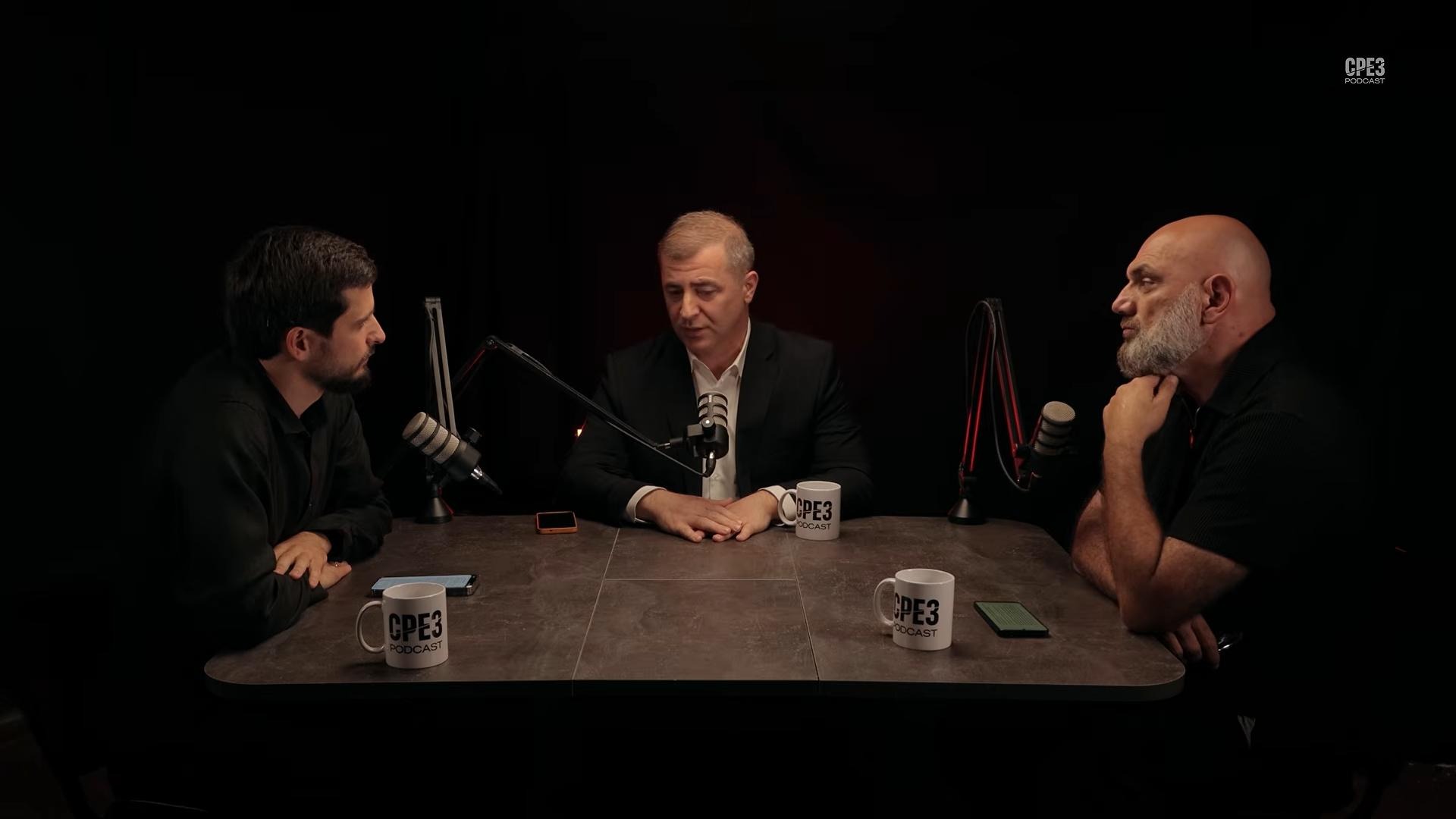
On July 18 of this year, the YouTube channel “Birth of Georgia” published an interview with Gia Baramidze, Georgia’s former State Minister. Speaking about the war in Abkhazia, he stated that during the first stage of the war the Georgian side did not take enemy fighters prisoner, because those who were captured were shot. This statement sparked a heated debate in both Georgian and Abkhaz society. Moreover, it led to criminal proceedings being opened in Georgia. On September 11, Baramidze was arrested on charges of high treason and sabotage.
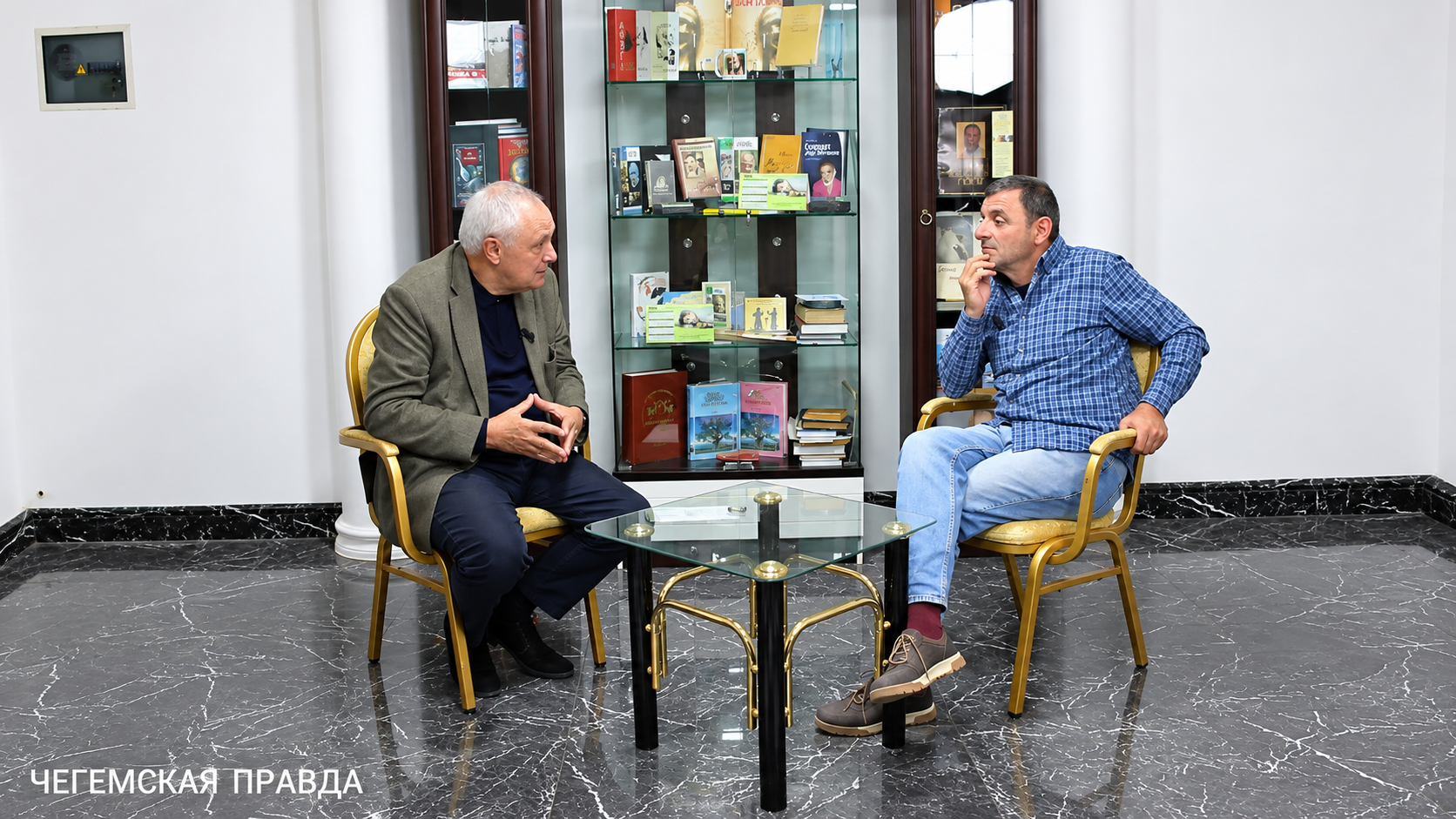
On August 7, the same YouTube channel published an interview with Paata Zakareishvili, who was the member of the commission for the exchange of prisoners of war during the war in Abkhazia. The interview gave particular attention to the issues of prisoners of war and hostages, as well as to the various tragic events that took place during the war.
Key Theses and Arguments:
Iago Khvichia: We will discuss in detail the events in Abkhazia, focusing on issues related to the exchange of prisoners. How was this process organized, and how did it work? When it comes to the mistreatment of prisoners, what responsibility, if any, did each side bear – the Georgian side and the Abkhaz side?
Thank you very much for joining me.
Paata Zakareishvili: Thank you very much, Iago! Greetings to you. And greetings to our viewers.
What is currently being discussed in Georgian society is indeed a painful subject. The problems that existed in Abkhazia in the 1990s – the issue of prisoners… and not just prisoners, but also hostages, the repatriation of remains, and displaced persons. There were numerous humanitarian issues, and prisoners were among them. I was directly involved in dealing with these matters on behalf of the state. I was a government official at the time, and now that this painful subject has been brought to the fore, it would be good if we could speak as openly and comprehensively as possible about everything.
As I always do, I speak honestly and tell the truth, and I want the public to know what was happening back then.
Iago Khvichia: All right, then, let’s begin. May God be on our side!
Hello, friends. It turns out that today we are recording the program under special circumstances. Today is August 7, and my guest is Paata Zakareishvili, who has appeared on my program twice before.
We discussed these issues in detail in the format of “The Birth of Georgia,” including such painful subjects as the War in Abkhazia, the coup, the so-called putsch, and so on.
However, I had already wanted to invite Mr. Paata to the “Nine Years” program. After all, we got to know each other during that period, the nine years of Mikheil Saakashvili’s rule, and I had the opportunity to hear your views even back then. It would be very interesting to hear them again now.
However, the reason for bringing this program forward was a segment featuring Mr. Giorgi Baramidze that aired on one of our previous programs and became the subject of a scandal in our society. It has caused a tremendous public uproar.
Rather than having to comment on every single aspect of the issue individually, I want to use this program, in a way, to state my position and clarify it for myself. I hope to do so, among other things, through our conversation.
Before speaking with you, I spoke with Mr. Gia Karkarashvili. I also heard his position on this issue. When I told him that I was interviewing Mr. Paata today, he said that Paata knows everything about this subject and that he trusts the information you will provide.
Let me begin directly with the War in Abkhazia.
How did the War in Abkhazia begin? How did you first learn about it? And when Mr. Gia Baramidze said that we had no prisoners at the beginning of the war, what did that mean? More generally, how do you view the situation?
I do not want Mr. Gia Baramidze’s statement itself to be the subject of this part of our program. Instead, I want us to recount the history, which should in itself provide an answer as to what was true in that statement.
Paata Zakareishvili: How does a war begin?
The actual hostilities began on August 14, 1992. At that time, the State Council was still in power. Shevardnadze had only recently arrived. He came in March; Shevardnadze returned to Georgia in March 1992.
A war was raging in Tskhinvali – not a full-scale, ferocious war in the literal sense, but a fairly ruthless and dishonorable one. It was a murky, confusing conflict.
Zviad Gamsakhurdia had been forced to leave Georgia in January, and Shevardnadze arrived in March. There was a Military Council led by Tengiz Kitovani and Jaba Ioseliani. These two were essentially running everything. Tengiz Sigua was regarded as the third member, but he did not put his signature to anything. It seems that his role was limited to that of prime minister, while the actual political decisions were made by Kitovani and Ioseliani.
Shevardnadze arrived in March, and by June the hostilities in Tskhinvali had come to an end with astonishing speed, taking everyone by surprise. It happened so quickly that Shevardnadze effectively demonstrated that he was capable of getting something serious done.
At that time, I was a member of the Republican Party. I was interested in political affairs and involved in these developments, so I also learned what was happening around me through my party. Members of our party had already become members of the State Council. Under Shevardnadze, the Military Council had been transformed into the State Council. He was its leader, with Kitovani and Ioseliani at his side. Sigua was also part of the picture: he was the influential prime minister and clearly a force to be reckoned with.
Since Shevardnadze was considered a “European” and was a popular figure, he established a Human Rights Committee in Georgia in May. It was a state institution, headed by Sandro Kavsadze. Kavsadze began recruiting young people, primarily.
At the time, I was studying at the Theological Academy. Zurab Kiknadze was my professor. May God rest his soul. He was truly a fantastic person, one of those who played a significant role in my life.
At the Academy, we used to debate religious freedoms: who had what rights, one church and another church, Islam and Christianity. I always stood out for my liberal views, views grounded in equality and justice.
Zurab Kiknadze told me that a committee had been established and that he had been appointed Kavsadze’s deputy. He invited me to join. There was a salary, there was some work to do, and I had a family to support. The country was genuinely devastated; everything had collapsed. I would at least earn a few pennies. I was supposed to head the religious affairs division. The Parliament building is behind us here, where we are recording this interview. We were given several rooms in this ruined building, and that is where I began working. This was in May.
That is where my career began – the work I have continued to pursue ever since, and which has given me a certain public profile.
We began recruiting young people. I was among the first to start working there. Zurab Kiknadze and I formed the committee responsible for selecting young applicants. One of the young people we subsequently hired – perhaps we will talk about this later – was Mr. Mikheil Saakashvili. It was an almost comical situation…
Iago Khvichia: What position did you hire Saakashvili for?
Paata Zakareishvili: We hired him, but later I could no longer remember which department he was assigned to. At that time, everything was so poorly defined that we were all working across the entire field of human rights. Gradually, things became more structured, and I no longer remember which department or division he ended up in. But the two of us made the decision to hire him, and I will explain later how and why he came to us.
Meanwhile, Sandro Kavsadze, our boss, was kidnapped in Zugdidi. Tensions were running high; there was a civil war in the country. The situation was truly dire, and our superior, Sandro Kavsadze, had been abducted. We did not know whether he was in Gali or Zugdidi. I was left on my own. Zurab Kiknadze was the senior figure, so his [Kavsadze’s] deputy was now left in charge. We had no idea how to act or what to do.
In the meantime, military operations began as well – that is, troops started moving in. The prevailing feeling was that everything was part of the civil war.
Later, I became a specialist in this field. I read newspapers, and I have a unique archive. I do not have TV archives, but looking through the newspapers, you can see that on August 12, 13, and 14, there was virtually no mention of Abkhazia. The focus was on the civil war, on the internal conflict in Samegrelo [one of the central topics of your program], where bridges were being blown up, police facilities were being destroyed, clashes were taking place, and railway traffic had come to a halt.
At that time, a full-scale war was raging in Karabakh. If there was a war anywhere, it was in Karabakh. Armenia was completely blockaded, cut off by Azerbaijan. The only route available to it ran through Georgia. It was a vital lifeline. Food and everything else entered Armenia through our territory, yet railway lines and infrastructure in Georgia were being blown up repeatedly. That is why Shevardnadze decided to send in troops and restore order.
On August 10, a State Council meeting was held, during which various opinions and tensions emerged. According to accounts, Jaba Ioseliani was opposed, while someone else supported the move. In the end, Shevardnadze… I remember these details from members of our party who sat on the State Council. They told me that Shevardnadze concluded his speech by saying something along the lines of: “You are sitting comfortably here, lounging around in Tbilisi, and you have no idea what is happening over there. Our compatriots there are facing problems.”
I believe he brought down several representatives of the Supreme Council from Sokhumi – possibly Nadareishvili as well, although I do not remember exactly. Still, I think I am close to the truth. They said that the situation there had become extremely difficult, that Sokhumi needed support, and that it would be good if something were done to provide assistance and restore the railway. The decision was made to reopen the railway. This led to the deployment of armed forces.
I am recounting all this very briefly. There are many more details. Since our main subject is prisoners, these issues could be discussed separately. There are numerous witnesses…
Iago Khvichia: So, are you saying that when Shevardnadze made that statement, he was effectively giving the green light to start a war in Abkhazia – to launch a military operation or something of that kind – or was he simply authorizing the clearing and reopening of the railway?
Paata Zakareishvili: There was constant talk about the railway. What he had in mind is another matter, but it seems that the railway was also the subject of discussion in the press, or perhaps at that meeting of the State Council, specifically so that members of the Republican Party would hear about it.
As soon as they entered, a clash took place that same day, either in the Ochamchire District or in the Guliripshi District. That was when the first casualties occurred. The first prisoners were also taken then, but they were suddenly released afterward.
It is fair to say that the forces entering in the direction of the road to Sokhumi were disorganized. Our armed forces were not well organized.
The key point is that everyone knows they were not going to war! Everyone who recalls anything from that period knows that their operation was temporary and intended solely to protect the railway. In other words, the order came from Tbilisi down to the officer, and the officer explained it to the fighters, for example, with the railway being the central focus.
That is my own conclusion. Resistance began there: they encountered an Abkhaz ambush on the road. It was either in Guliripshi or in the Ochamchire District, beyond Gali. I cannot remember exactly.
The first shots were fired, the first casualties occurred, and this came as a surprise. In other words, no one expected it.
Iago Khvichia: Were the first casualties on the Georgian side?
Paata Zakareishvili: Yes, they were Georgian. The first casualties were on our side. Our men took prisoners. There is a very strange episode in which our men captured prisoners, I think they brought them into Gali and handed them over to the police. Then, within a day or two, all those prisoners were out. To this day, that remains something of an unexplained mystery. The Georgians took 20 or 30 people prisoner and then released them.
Iago Khvichia: I spoke to Gia Karkarashvili today and asked his permission to quote him on this program. According to him, initially they did not hold prisoners – not because they were killing them, but because they simply handed them back to the other side so that tensions would ease after the initial escalation.
Paata Zakareishvili: That happened a little later. I am telling you about the first days and the first hours. On the first day, when the first group of prisoners was taken, they [Georgian troops] had not yet reached Sokhumi.
I have this well documented in my records. I have a fairly extensive archive. There are so many episodes from this war that each one could be the subject of an entire program. The Lata incident, the amphibious landing, the March offensive, Sokhumi Hydroelectric Power Station… so many, many events. And it is not just me – there are many people who know these stories, and they contain very important details.
The first few days are the most obscure. The factor involving Zviad Gamsakhurdia’s supporters was significant, as were the negotiations with them. We all know about the negotiations in the final days of the war. But negotiations with them were also taking place during the first days of the war.
Iago Khvichia: Mr. Gia Baramidze emphasized that he was referring to the initial phase. So I think what happened to the prisoners during that first phase is genuinely important. You are saying that they were simply released, and no one found out who had released them?
Paata Zakareishvili: Yes, this was in the early days. This is such an obscure episode that only a handful of people know about it. I can look through my archives and find recollections, for example, by Rudik Tsatava. Rudik Tsatava was the head of the Gali administration. He recounts this directly. These prisoners were in his custody.
Iago Khvichia: What does he say about why they were released?
Paata Zakareishvili: No, I have read about it; he published it somewhere. I don’t know why they were released, but he himself was surprised. The prisoners were captured and handed over to the police, but then…
I don’t see anything wrong with this, because the war had not even begun yet. This episode seems more like a misunderstanding of some kind.
This is the first episode involving prisoners that I consider an instance of the Georgian side acting appropriately…
Iago Khvichia: Had they not captured any Georgian prisoners by that point?
Paata Zakareishvili: Not at that point.
Nevertheless, I am always willing to hear any other opinion, because these episodes interest me greatly, and I am collecting material about them.
What I am telling you now, in these five minutes, concerns a period when I was not yet involved in the process. I became involved in October.
It can confidently be said that, from August to September, the war had a somewhat romantic character: there was a feeling that it would be over very soon, that it was all some kind of misunderstanding. The structure of the war, as such, had not even taken shape yet. There were shootings and occasional deaths, but this was still not an everyday occurrence.
Тhe real, brutal, merciless, deliberate war began with the capture of Gagra; it began with the fall of Gagra, when we were forced to leave the city. Gagra showed us what we were actually dealing with.
Iago Khvichia: The incident Mr. Baramidze talks about took place before Gagra. What cases involving the treatment of prisoners occurred before Gagra?
Paata Zakareishvili: Before Gagra, there was no commission. Karkarashvili was doing most of the work.
There is a well-known film called “Liza, Go On”. It contains a scene that appears to be based on Karkarashvili’s account, because the actor himself portrays Karkarashvili. This is quite clear, although the surname is not mentioned in the film. The Abkhaz surnames have also been changed. Another person was involved in that particular incident. The episode is so important that it was included in the film. It seems to have been a painful episode for Karkarashvili, which is why it features as one of the film’s central moments. What exactly happens in this scene?
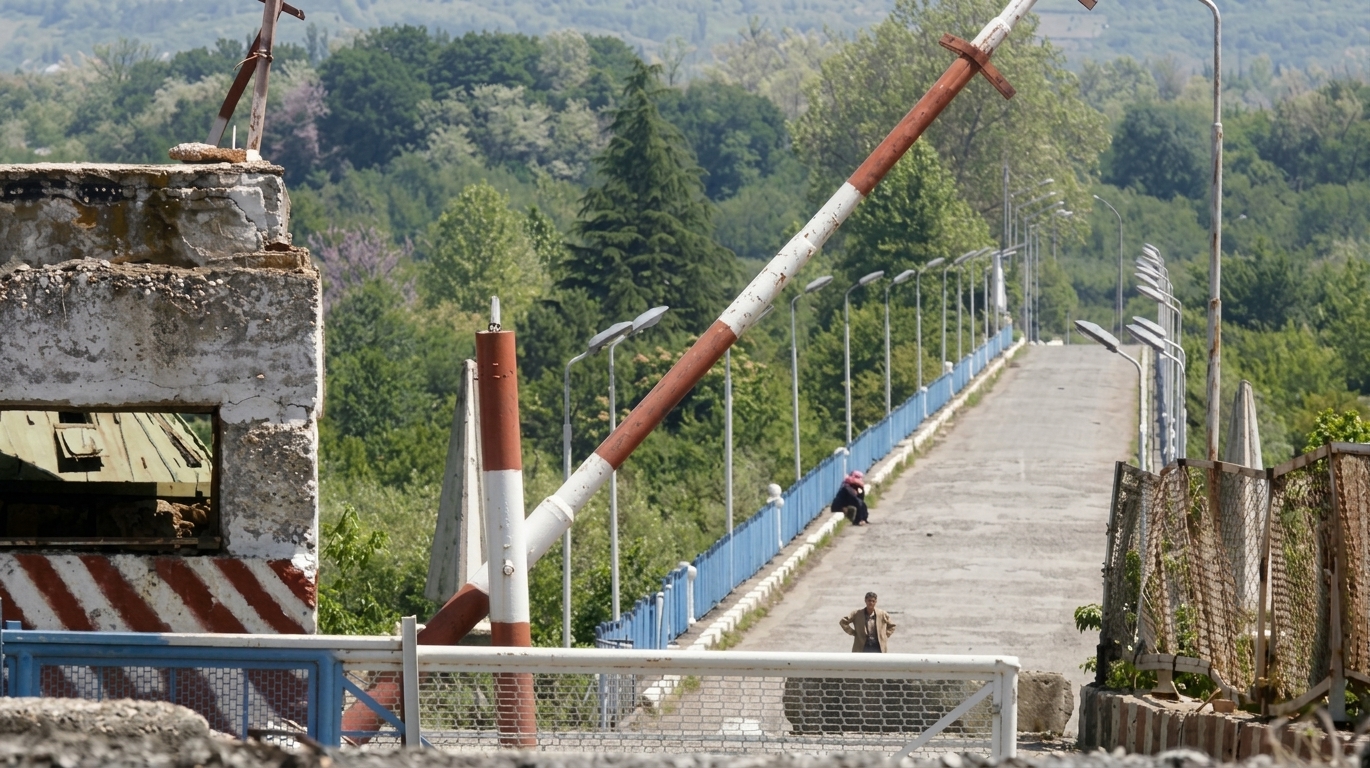
All of this takes place before Gagra, after prisoners have been captured. A prisoner exchange was arranged at Achadara Bridge. There are two bridges over the Gumista. Below is the railway and road bridge, and above it is Achadara Bridge, which people in Sokhumi call the upper bridge. It is a beautiful bridge with arches.
It may have been the very first prisoner exchange, or at least one of the first.
Karkarashvili took part on one side, while the other side was represented by a fairly high-ranking figure. That was Alexander Ankvab, who was the interior minister on the Abkhaz side. How he became minister is another story. There were all sorts of developments, including the case with Lominadze, and there is a very interesting history behind this war.
In short, Ankvab was there, and something extraordinary happened. It is almost the stuff of a Caucasian legend. An exchange took place in some form – two for two, or something along those lines. Once the exchange had been completed, two Georgian men had crossed over to our side, while the Abkhaz had crossed to the other side. Suddenly, gunfire erupted from somewhere. [Achadara Bridge is in a mountainous area.] Our two prisoners, who had already been exchanged and had already crossed over to our side, were killed.
It is quite clear that the Abkhaz killed them.
And that answers your question about who did this more often… We will talk about that again.
This was the first publicly documented incident that can be cited and for which there were witnesses – the first case in which prisoners who had already been released were killed.
The Abkhaz must have killed them. Surely the Georgians wouldn’t have killed their own prisoners?!
This is horrifying, of course, but then an extraordinary story begins.
Ankvab immediately walks across the bridge on foot and surrenders himself to the Georgian side, to Karkarashvili. He says that we failed to keep our promise; what happened is unheard of and unimaginable, and here I am, in your hands. Let us negotiate.
Everyone is stunned. They put him in a car and took him to Sokhumi. There are people there who want to settle scores with him, to make him pay. After all, two young men have just been killed.
At this stage, such deaths are still unprecedented. These are the very first steps of the war. Every death feels like a shocking, almost unreal event. It is against this backdrop that everything unfolds.
Many people in Sokhumi know Ankvab, but many cannot stand him, because he had already been involved in certain incidents connected with Lominadze, as well as in other contexts.
In short, as far as I know, Karkarashvili acted with considerable dignity and principle. He said that the man had crossed over of his own accord, and it was quite clear that what had happened was not his fault. I may not be telling everything in full, or I may be deliberately leaving some things out; conversely, I may be saying too much. But it was Karkarashvili’s decision that led to Ankvab’s release.
The news spread immediately.
I was there too, but at that stage I was still nobody of any significance. Everything that was happening reached me by word of mouth. If I may put it this way, I was entering the war because I had been sent from Tbilisi. Baramidze may have been with me at the time. I don’t remember. This was my first trip to Sokhumi as a member of the commission, to get a clearer understanding of what was going on.
The commission was established practically as soon as the war began. How was it set up? Shevardnadze was, after all, a Soviet man. Kavsadze was also a Soviet man. I say this without any irony whatsoever. I have enormous respect for him, and I genuinely believe that Sandro Kavsadze played a very important role in my life.
The commission was established along Soviet lines. One chairman came from one ministry, another from a different ministry, and so on. The commission was formed on the basis of our Human Rights Committee. Most of us were staff members: myself, Baramidze, and others. I am certain that Baramidze was appointed Kavsadze’s deputy. I read somewhere else that I had supposedly been his deputy, which is incorrect. It doesn’t really matter to me; I could have been anyone’s deputy. But Kavsadze’s deputy was Baramidze. I was an ordinary member of the commission. The commission was large, with fifteen to twenty people, many of whom had no idea what being a commission member actually meant.
One of my first assignments was essentially: “Go there and figure out what kind of commission you’re a member of!” I would make a point of showing initiative. I am still an enterprising person, and back then I was even more so, especially since I was young.
I remember one particularly important episode. When I first arrived, I was staying at the state dacha – Stalin’s dacha. The mandarins were tiny and green. I thought to myself, “Why have I come here at this time of year? I can’t even eat the mandarins yet.” Little did I know! I ended up spending the entire year in Abkhazia eating practically nothing but mandarins.
We were so convinced that everything would be over in two or three weeks. In other words, nobody had any sense that this was something serious. Everyone felt that it would all be over very soon. I, too, had gone there on an official assignment, essentially to register the fact that our commission had arrived and had done a few things. At that stage, the situation was still being treated very casually.
Meanwhile, the capture of Gagra was approaching. Before Gagra, there had been several clashes, and several young men had been taken prisoner. I remember two Svan boys, and we took part in exchanging them.
Iago Khvichia: What did you exchange them for?
Paata Zakareishvili: We handed over some people ourselves.
Iago Khvichia: So we had prisoners too at that point?
Paata Zakareishvili: Yes. From the perspective of today, in 2026, a prisoner of war is someone who was wearing a military uniform and carrying a weapon… In most cases, the people we now remember as prisoners of war were actually hostages.
Iago Khvichia: Civilians who had been detained?
Paata Zakareishvili: Civilians, the ones who had taken up arms and were carrying hunting rifles. In other words, things had not yet fully taken shape.
If I’m not mistaken, those young men were from Gagra. They had Svan surnames. One of them was a big, strong, burly fellow. He was built like a wardrobe. He had been wounded in the leg. This was the first prisoner exchange I personally witnessed. I was already taking part in the negotiations, but from then on I participated in negotiations all the time. My signature is on every document.
That is how the first exchanges took place.
Gia Baramidze talks a great deal about the commission. In reality, the commission was not functioning. It was a Soviet-style commission. Meanwhile, parliamentary elections were held in Georgia during the war, and Gia Baramidze became a member of parliament. He dropped out of the commission. It was a government commission.
There is no doubt about one thing: he was genuinely interested. We were friends. He would call me, I would call him, and I would tell him that an exchange was taking place at this time or another exchange at that time. He would come down whenever that happened.
But I’ll be frank: he was not involved in any of the commission’s actual work. You won’t find a single protocol anywhere documenting the negotiations… [I have all the protocols.] As a rule, two people took part in the negotiations: Valeri Vashakidze and me. Vashakidze was responsible for issues concerning displaced persons. He was the first minister in charge of displaced persons’ affairs. I was responsible for prisoners: prisoners, missing persons, and hostages. If an issue concerned displaced persons, Valeri Vashakidze led the commission’s work with the Abkhaz and Russian sides. These were three-way relations. If it concerned prisoners, I led the work. Whenever a protocol concerned my area of responsibility, it bore my signature; whenever it concerned Vashakidze’s, it bore his.
You won’t find Baramidze’s name anywhere. If he wanted to prove that he was a member of the commission, the only thing he could produce would be a government decision listing him as a member. There are so many surnames on that document. Many people – if they are still alive today – may not even know that they were members of the commission. In other words, he has no evidence beyond that.
Once a month, I wrote a report on our activities. As a rule, I addressed it to Shevardnadze. Shevardnadze was in Sokhumi most of the time, while Kavsadze was mainly in Tbilisi. Shevardnadze was often in Sokhumi. Kavsadze would tell me directly, “It wouldn’t be appropriate for you to address a memorandum to me now, when it is intended for Shevardnadze.” So I addressed the reports directly to Shevardnadze. I would leave them with his secretary. All of this took place at Stalin’s dacha. At some point, the secretary would call me or come looking for me. There were no mobile phones. In any case, I was always either at headquarters or at the dacha. “Mr. Eduard asks you to come in,” the secretary would say. I would go in. The place was laid out like hotel rooms. I would sit at the table and explain what was happening. I also went to Gudauta frequently, and whenever I returned, I would report back.
Baramidze cannot produce any document or any report addressed to someone else.
My trip had been officially authorized as a government assignment. I had been sent to Abkhazia on an official government mission. At the time, coupons were the currency. When the war ended and I returned, I was paid. In the end, after working for a year and a half – or perhaps a year and two months – I used all the coupons I had earned to buy half a sack of flour. That was, so to speak, the entire spoils I brought back from the war in Abkhazia. The coupons kept losing value, over and over again. They paid me the entire amount for my official mission all at once, and I thought, “How wonderful! Look how much money I have!” But it turned out that all I could get was half a sack of flour, and my three children were waiting for me at home.
Baramidze came down on his own. If parliament sent him on an official mission, then fine, but the commission itself never…
Iago Khvichia: I don’t think anyone disputes that Baramidze went there at some point. Nor, I think, does anyone dispute that prisoner exchanges took place. You took part in them too. Let’s put it this way: where is the grain of truth in what Baramidze said, and where was he mistaken or lying? Assess it however you see fit.
Paata Zakareishvili: He was my friend, and what he said really wasn’t worth all this commotion. But it affected everyone because he insulted every combatant. What his argument effectively amounts to is that, because there was no discipline…
Discipline on our side was indeed weak. The Abkhaz side was more disciplined. I agree with him on that. That is the one truth in what he said: they had discipline, while discipline on our side was seriously lacking. But the absence of discipline does not mean that everyone was a murderer. That is what made people so angry.
Put yourself in this situation: you are at war, serving in the army, and your officer is no good. There is no discipline. People get up whenever they want, go to sleep whenever they want, come and go as they please. Are you going to pick up an assault rifle, storm a prison, and shoot the prisoners? In other words, a lack of discipline is not directly correlated with the killing of prisoners. That is one point. And the second is this:
Speaking confidently, as someone competent in this field, I can say with confidence that significantly more prisoners were killed – executed – by the Abkhaz side than by the Georgian side.
There really were several incidents. There were also one or two executions on the Georgian side, and the response was very strict, with the prosecutor’s office becoming involved. Karkarashvili himself would sometimes go absolutely ballistic. He dealt with people very harshly and berated them severely.
If we had a problem with prisoners, it was that the battalions would not hand them over to us. A battalion would capture a prisoner and hide him. Why hide him? If they intended to execute him, they would have executed him, wouldn’t they? Why keep him hidden?
They kept prisoners because, if one of their own men fell into enemy hands, they had no confidence that we would help secure his release quickly. There were cases like that. They kept prisoners hidden. They certainly did not keep them in good conditions, and when they captured someone, they would exchange him for a prisoner already in their custody, or send word that they were holding a particular prisoner.
What Kavsadze and I personally fought against was precisely this, and that is why we were constantly arguing with Karkarashvili. I was not Karkarashvili’s equal in rank at the time, so whenever I had a complaint, I would call Kavsadze, and Kavsadze would call Karkarashvili. We would then work things out by pointing out that a particular battalion was holding prisoners. If they wanted to execute them, they could have done so – what would have stopped them? That is not how it worked.
Executions happened only rarely, for example, when someone was captured in a forest and resisted. I can remember only about four or five such cases. There were dozens of cases like that on the Abkhaz side.
When Kaman was captured, I brought out every body. Every single one. They were Svans. They were extraordinary people. It was a horrific scene.
The Abkhaz handed over two truckloads of bodies from Kaman. I brought out two truckloads, and not a single person was alive! That is absurd, Iago.
It is impossible for a unit to be surrounded, run out of ammunition, have the enemy standing right over it, and still refuse to surrender. That is a fairy tale! Those who are dead are dead, but the survival instinct kicks in for those who are alive: I have no weapon, I have no ammunition, so I raise my hands and surrender. There is no point in doing otherwise. You’re not going to fight them with your teeth, are you?! As a rule, at least some of the people in a surrounded unit – people who are already unarmed and have run out of ammunition – surrender as prisoners. You cannot simply kill yourself. It is absurd. They do not kill themselves; it is a natural instinct to surrender.
After Kaman, not a single living person was handed over to me. Not one. They were all dead.
It is impossible that nobody there surrendered. Impossible! I am 100% certain that everyone… as witnesses, at the very least… What is more, a priest surrendered there at the time. There was a priest there. It is a well-known episode. The priest from the Kaman monastery surrendered as a prisoner. Where is he? They killed him! They killed him!
It all began in Gagra. The capture of Gagra was brutally violent.
We entered in August. Gagra was captured on October 2, between October 2 and 5.
That was when the horrific killings took place in Gagra. We all heard about them. They really were carried out in appalling ways: people were dragged out of apartment-building entrances and shot in the street…
If someone thinks there is a distinction between a hostage and a prisoner of war, then, as a human being who saw everything, I can tell you that there is no difference.
Someone knew that a particular young man, who lived on the fifth floor, had fought against us, against the Abkhaz. “There he is – drag him out!” No trial, no investigation, no attempt to establish the facts! Shoot him! They shot people in courtyards so that others could see. They did not shoot every Georgian, but they did shoot those about whom they had some information.
Does Gia not know this? He was a minister, after all – the defence minister and the interior minister. He had access to classified documents. If he is so certain, he should have investigated and examined the documents.
There were atrocities on both sides, but the two cannot be compared. I can say with confidence that, in terms of scale, if not one to five, then one to ten of all this rests on the Abkhaz conscience.
Why? What was the reason? Because they were more brutal than we were? No!
They took the territory gradually, advancing bit by bit. We lost Gagra. Then there was Kochara, in the Ochamchire district, where many terrible things also happened. When you take control of territory, people are left behind there, including civilians. There are women, elderly people, old men. They think and hope that no one will harm them. The troops enter and shoot them on the spot.
Yes, those people are hostages, but the same rules and laws that apply to prisoners of war also apply to hostages. In fact, the requirements are often even stricter.
That is why I disagree with Gia’s assessment that we supposedly did something more…
Iago Khvichia: Gia said that, at the initial stage, we did not have any prisoners. What does that mean in general? Does it mean that we genuinely had no prisoners? Or does it mean that, naturally, we would have had fewer because they were the ones occupying the territory?
Paata Zakareishvili: We always had fewer prisoners. Always!
My principle was that we should always exchange everyone for everyone. This was a matter of fundamental importance. We had 10, while they had 50 prisoners. Fifty for ten.
I have all the protocols. Let Gia show me even one protocol bearing his signature. Let him show me even one protocol with his surname on it, indicating that Baramidze took part in the negotiations.
He mentions Beslan Kobakhia. Beslan has signed all the documents with me. In fact, Saakashvili once came down, practically forced his way into our car, and met Beslan Kobakhia so that he could later claim that he, too, had spoken with Beslan Kobakhia. He was no hero. He was an ordinary person representing the Abkhaz side.
The chairman of the commission on the other side was Ankvab, while on our side it was Sandro Kavsadze. Beslan Kobakhia was someone much like me: we were the people who maintained direct contact and were authorized to take part in negotiations and sign decisions. The Red Cross and all the other participants came into the picture later. In terms of direct, operational communication, there were just the two of us.
We worked very quickly. Decisions were made on the spot. We communicated by radio and would make decisions over the radio as well. I was constantly going back and forth under a white flag, crossing over to the other side. I could cross freely, and the Abkhaz were astonished at how I managed to travel to Gudauta without any of the usual formalities or precautions…
I was even authorized to carry a weapon, but I did not carry one because I did not want someone to shoot me dead over it. That was a real possibility. If someone had known I was armed, they might have killed me simply because I had a weapon. So I insisted, as a matter of principle, that I had no weapon, had never had one, and never carried one. Although I was allowed to carry one, and they even offered me weapons, I never took one.
What is the key point here? Baramidze was a very enthusiastic young man, let’s put it that way, fired up with patriotic zeal. He wanted to get something out of being involved in the war, to contribute something, to make a name for himself.
Granted, but he did not take part in the commission’s work. I say that unequivocally. He cannot prove otherwise.
He has been summoned to the Prosecutor’s Office now, hasn’t he? If the Prosecutor’s Office is to handle the case properly, what is the first thing it must do? It must prove that Baramidze was a member of the commission. It will not be able to prove that. They will not be able to establish it. There is no record of his work anywhere; his signature appears nowhere.
It is awkward to say this, but what he says sounds more like gossip. You should not put someone in prison for gossip.
Iago Khvichia: As for the Prosecutor’s Office, I think this is completely absurd.
Paata Zakareishvili: Absolutely. I also believe it is wrong, because I have heard countless stories of this kind.
Once, we were at a feast in Poti. We had brought out a group of prisoners. There was a ship called the Spartak. In the end, the ship itself remained with the Abkhaz, but we managed to bring the people out. A feast was organized in Poti. Most of the young men there were from Poti. During the feast, one fellow stood up and announced that he had been at a secret detention facility for prisoners in Gudauta. I immediately pricked up my ears. That is exactly the kind of thing I am always trying to find out about; nothing else interests me as much. He was boasting about what a brave and important person he was, saying that he had been involved in some secret operation. When the toast was over, I took him aside and said: “I am so-and-so. I was the one who brought out the people who are here now. So, if you don’t mind, tell me where this place is and how the whole thing works.” Excuse my language, but he completely lost his nerve on the spot. He immediately realized he had made a serious mistake. He said he did not actually know anything about it; someone else had told him. I said, “Then bring me the person who told you.” He denied everything. Not only did he deny having been at that camp himself – that was one thing – but he also denied that anyone had ever told him about it.
How do these legends spread? “Someone told me,” and so on.
There is a brilliant scene in the film I See the Sun. It shows photographs of twin boys. Some people are selling corn, and when they see the photograph in a family’s home, they ask who the boys are. The mother says, “They are my sons. They went off to war and disappeared.” Then, right there on the spot, they start inventing a story. It is a lovely scene. “Remember what that person told us? He said he had been there during that war, and someone had seen the twins…” And so they encourage the mother and warm her heart with the thought that the twins might still be alive.
That is how these legends keep floating around. They do not really circulate anymore, but back then they were everywhere.
What is more, some people were making money out of it. They would call parents and tell them: “We are not asking for much. You know, we have negotiations going on in Sochi, and your child’s case will be discussed there. We do not need much – just 300 or 400 dollars for travel expenses, so that we can go there and come back. If your child is brought out, then, of course, you can show your gratitude.” And these poor people would hand over 300, 400, even 100 dollars… In other words, there are people who = and perhaps psychologists should be the ones to discuss this in greater depth – enjoy becoming the hero of some story, the positive character in a legend. You know people like that, and so do I. It is a familiar phenomenon, a perfectly recognizable psychological type. It is entirely understandable.
That is the only explanation I can think of for why he needed to tell such a lie.
The execution at Sovmin. All the prisoners were being held at Sovmin. Shartava and his team were there.
Misha Kokaia was my friend. Gia used to stay with him whenever he came down. When Gia came, he would stay at Misha Kokaia’s apartment. We lived with the Kokaia family. I had no home in Sokhumi, no place of my own. I would either sleep at headquarters, sleep at Sovmin, or, as was usually the case, stay at the Kokaia family home. I lived there with Misha.
Misha disappeared. Unfortunately, it seems he was killed as well. To this day, we have been unable to find out what happened to him or trace his whereabouts.
My greatest pain connected with Sokhumi is the loss of Misha Kokaia, my dearest friend. I met him there.
Was Misha not a prisoner?
Forty or fifty people were executed then, shot on the spot, when Sokhumi fell. And how many others were executed in other parts of the city during the fall of Sokhumi?
War is not good. War is horrific! It brings out the most immoral, the most vile traits in human beings. There are many people capable of doing terrible things. But we cannot say that one side was in a better situation and the other in a worse one. Our side did not consist of angels either, and there were certainly many people who were ready and willing to fight.
It is very important to explain how I first became involved with the commission. In the end, the commission had exhausted its purpose from the very first day, as soon as it had been established… I went there and realized that nothing would come of it unless I worked on the ground. That is why I never returned to Tbilisi. That is one thing. But that is not the main point.
A team was formed there. The Ministry of Defence – Karkarashvili, to put it that way – assigned me to what was effectively the Ministry of Defence’s press service. Soso Margishvili was in charge. May God rest his soul. He died very young, after the war.
Every day, news broadcasts went out in which they would say: “We spotted an enemy patrol boat, and the Georgians sank it. Then we spotted a tank and blew it up.” Eventually, other people began making fun of us: “Just how many tanks and patrol boats do these Abkhaz have, if the Georgians are sinking one every single day?” So we reduced the frequency of the announcements, and eventually we made them only once every three days. In other words, we were trying to shape the psychological mood.
Iago Khvichia: So, war propaganda.
Paata Zakareishvili: Yes, war propaganda. That is normal. This was the headquarters where I worked. Some well-known journalists even today were there. For example, Irakli Aladashvili, a military expert; Koba Liklikadze, who was a presenter at Radio Liberty; and Malkhaz Topuria, a military man who was absolutely fearless. As Georgians sometimes say, he was like someone without a body – almost invulnerable. He would go into battle and come back out without a single scratch.
If anyone was doing the work, and I was coordinating it, it was these people. I had no car, no petrol, no money, no proper clothes. Wherever I happened to fall asleep was where I woke up. I was there with these people… Sometimes I would ask Soso to lend me a car, and then… There were countless incidents involving his car. We were bombed, too. Anyway, these were the people…
If there was any commission that genuinely did its work, without any paperwork or signatures, it was this group gathered around Soso Margishvili. These young men and I really were like one family, one team, one unit.
With all due respect, Gia was not there!
He had taken some bold steps, certainly. Once, during Shartava’s time, we went to Gudauta. The Abkhazians were handing over prisoners. It was another prisoner handover. I already knew in advance—I had been told beforehand—that the handover would not take place that day. Shartava had come, and you had come too, but they said the prisoners would not be handed over that day and that they would transfer them to us in a few days. We were already experienced by then. We had been dealing with the Abkhazians for a long time; we knew the ropes and had learned not to expect them to deceive us. So I was willing to accept that. Gia came down and said, “No. If you do not hand them over, I am not leaving here.” And he stayed! We were all surprised. It was certainly a bold move, but it achieved nothing. They would have handed those prisoners over to us anyway. But he apparently felt that leaving without them would be inconsistent with his conscience, so he stayed. Two days later, they handed over the prisoners, and Gia returned as well.
I will be frank: Gia’s presence or absence there made no difference. It neither added anything to the work nor took anything away from it.
I will tell you honestly: without me and those young men, a great many people would not be alive today. Many people would not have been brought back, and their families would not have had their sons’ bodies laid to rest in their graves. It was with these very hands that we dug up the bodies of our boys and brought them back.
Most displaced people managed to get out on their own, taking their own risks. There was no state apparatus to speak of. This was particularly true of the displaced people from the villages beyond the Gumista River. But we, acting on behalf of the state, did manage to evacuate some people. I was coordinating that effort.
The villages of Bzipi, Alakhadze, Lidzava, Likhni, Akhalsofeli in the Gudauta area, and the Third Kilometre—these were the names given to the villages, such as the Third and Seventh Kilometres—I was responsible for evacuating all of them. But that was just a drop in the ocean. The people evacuated by the state accounted for only 20 percent of all displaced persons. The rest made their own way out, at their own risk.
Let Gia say honestly why we were evacuating those villages.
Not a single week went by without someone being killed there. Not a single week passed without young men being taken away – usually boys of fighting age. They were held hostage for some time, and then they would turn up dead. Their bodies would subsequently be returned to their families. The situation had become unbearable.
So yes, I took part in these evacuations because we had no other choice. As a rule, the parents of the fighters who had come over to our side were being killed. The people there would find out that a particular fighter was fighting, that he was in Sokhumi, and then they would track down his parents, whether they were in Alakhadze or somewhere else…
Iago Khvichia: Were they the ones who controlled the situation in those villages?
Paata Zakareishvili: It was not particularly difficult to work out whose son was fighting where.
Iago Khvichia: No, no. I mean, were Abkhaz in control of law and order in those villages at the time?
Paata Zakareishvili: The Abkhaz? Of course. I mean the areas on their side, beyond the Gumista River. That is, the Gudauta district and Bichvinta, as well as the Gagra district. Of course, those areas were under Abkhaz control.
Iago Khvichia: All right. What happened between Gagra and Sokhumi? I understand that this covers a long period, but could you give us some context, including the humanitarian situation?
Paata Zakareishvili: I will give you what you might call my non-military perspective. The situation was that the fighting had already become positional warfare. Practically speaking, there was almost no movement on the front. There were some attempts in January, and then there was a major offensive in March.
I was there. I was there almost all the time, although I returned to Tbilisi once or twice to change my clothes. By “there,” I mean I was at Gumista, at the headquarters. The chief of staff there was a man from Racha. You can imagine – I was not going to run away! I used to sleep at headquarters. I had no other choice.
I was there when the offensive began. It was nighttime, in March. There was still snow on the ground. It had been a very harsh winter. I could see the line of fire stretching farther and farther until we found ourselves practically surrounded. That was when I said, “I know how to shoot. I have served in the army, so give me an assault rifle as well. Why should you have to die because of me?” I asked them to assign me a position. It was the first time I was prepared to take up a weapon and defend myself. There was shooting all night.
Our boys performed brilliantly, especially the artillerymen. I watched it with my own eyes. They would show me through binoculars how vehicles were exploding.
That was our greatest success. But it was a defensive success. It was an offensive that we managed to repel. After that March offensive, the Abkhaz realized that taking Sokhumi would be impossible, and this was a serious blow to them.
After March, they began building a road from the Sokhumi hydroelectric power station, from the area above it, to the north. [The Baratashvili Bridge is in Sokhumi.] People kept coming down from Baratashvili Street, saying, “A tractor is working! A tractor is working! Do something! Take action!” They built a road from that direction. And, in my view, we practically lost Sokhumi because of that route from the Baratashvili Bridge. That is my opinion. It would be better for military experts to explain this in greater detail.
Until they actually entered the city, we were practically there the whole time. What saved me was my work with the prisoners. As I mentioned when I spoke about Misha Kokaia, I was always by Shartava’s side.
I was very close to Shartava. It may not be appropriate to talk about this now, but for example, I slept in his room with him. When neither he nor I had anywhere else to sleep, we would stay at Sovmin. We slept in the same room once or twice – or rather, not just once or twice, but for a certain period of time. I accompanied him on all the trips to Gudauta for negotiations. Whenever we travelled, I would sit in his car. I did not have a car of my own, after all. So I rode with him. We would go, and the negotiations would take place. I spoke only about prisoners. The prisoners were a central issue. So whenever the subject of prisoners came up, I would get involved. All the negotiations were held in Sochi and Gudauta.
Iago Khvichia: Tell me a few words about Shartava’s role as well. I mean the Shartava you came to know during the war, and the period and process in which you had to work with him. What was he doing there? What was his purpose in travelling around those areas?
Paata Zakareishvili: Back in the days of Gamsakhurdia, when the first elections were held, under the Communists, Shartava and I ran against each other in Rustavi. At the time, Zhvania and I were on one side, while Shartava was representing the Communists. When he recognized me there, he said, “Oh, Paata! Aren’t you that Paata from Rustavi who used to fight against me?” In the end, Gamsakhurdia and the Round Table won. Both Shartava and I lost. That is how we first met.
He was a most noble man.
I knew two of Shevardnadze’s dearest friends, both of whom, so to speak, adored him and held him in very high regard. I knew Shartava and Kavsadze. Kavsadze is still alive, and may God grant him a long life. He is now the head of the Svetitskhoveli Cathedral. Kavsadze’s story is another story altogether – a unique story, a fantastic one.
I used to argue with both of them about one thing or another. They were older than me, but I really didn’t like Shevardnadze. “What is it about Shevardnadze that you find so appealing?” I would ask them. “Oh, come on, don’t ask me that,” Shartava would say. “You’re wrong. You don’t know that man. He isn’t what you think he is.”
In short, we became very close. We grew close very quickly during those negotiations. He could see, throughout the negotiations, how much I cared about the prisoners.
I was also deeply saddened by what happened to Baramidze, because we did everything we could to ensure that not a hair on the heads of the Abkhaz prisoners was harmed. I still believe that I am a humanist, that I genuinely care about people and stand up for human rights. But there was also a political consideration behind this: once a prisoner had been exchanged and returned home, he should not be saying that he had been tortured here.
Yes, when people were captured, they might get a blow to the head, and regrettable things may have happened. But the moment they came into our custody, that was the end of it. There was absolutely no question of speaking to them in a condescending or high-handed manner.
I was very close to Avto Ioseliani, the head of the Abkhazian security service, and to Temur – I’ll remember his surname. He was a general. Sadly, he died of COVID. He has a Svan surname. He was one of those people… The people from the security service were the ones who stood by me. Whenever I went to Gudauta, this man, the general, would stay awake all night, worried that something might happen to me there.
As for Shartava, I don’t know… I have never encountered such a noble Communist in my life. I had never had a high opinion of Communists, but he truly was an exceptionally conscientious and honest man.
I was always astonished. Ordinary Communists could be decent people, of course, but I could never have imagined someone in such a high-ranking position [if I’m not mistaken, he was the secretary of the Rustavi District Committee] being like that. I knew people of that standing as human beings who… Kavsadze, too, was the secretary of the Gori District Committee, if I’m not mistaken, and despite that, he was genuinely very…
Those two men changed my perception of high-ranking Communists.
We were very close. He trusted me. Both Kavsadze and Shartava trusted me. “Whatever you agree on, that’s how it will be.” Kavsadze would tell me, “If you find that the final decision rests with you, and something needs to be done – or else everything will fall apart – then make the decision in my name and do whatever is necessary.” And that is generally what we did.
Before Shartava, there was Nadareishvili. For some reason, he didn’t like me. He disliked me because I was always talking about the Abkhaz, about negotiations with the Abkhaz, and about equality, and that irritated him. But after some time, Nadareishvili left – Shevardnadze dismissed him – and brought in Shartava.
Shartava changed the situation considerably.
Iago Khvichia: What principles guided Shartava during this war? What was his position? What did he want to happen? What was he trying to achieve through this war?
Paata Zakareishvili: I attended the negotiations, but I wasn’t personally involved in them.
I believe Shartava’s main objective was to convince the Abkhaz that their interests could be protected through negotiations.
Our views coincided. I thought the same way. It’s possible that I learned a great deal from him; I wouldn’t rule that out.
We cannot achieve anything through war. This war is utterly unacceptable and unjustifiable. It was a deeply shameful affair, something that… The man is no longer alive, and it is difficult to speak on his behalf. It wouldn’t come out right… Somehow, we have to find common ground.
The Abkhaz liked talking to him. They trusted him. That is very important.
This is something that has stayed with me to this day in my own dealings with people. When you have their trust, they are much more willing to go along with you on many things. You must not betray that trust. In other words, you must not let them down. If you preserve their trust…
Thirty years have passed, and I have yet to see the Abkhaz side’s attitude toward me become even slightly strained.
Shartava was that kind of person, too. I wouldn’t rule out the possibility that I learned certain things from him, from watching how he spoke to the Abkhaz side.
His main concept was that Shevardnadze was willing to agree to anything; we were ready to accommodate them… Independence was not being discussed. The issue of independence only came up later, in the context of 2008. That was when they realized that an opportunity might have opened up for them. Before that, they had always spoken about it rather casually.
The central idea was that we would find a way to create conditions for you in Georgia that would be worthy of your dignity and status, and that we would do this together. We would not come to you with a proposal drawn up unilaterally. It had been a very bad practice for us – Tbilisi or Moscow – to offer you things that we considered beneficial for you. That would be ruled out. From then on, everything would be agreed with you and based on conditions put forward by you.
The Abkhaz understood that they could not extricate themselves from Georgia. In other words, they would inevitably have to maintain relations with Georgia. There was no clear prospect of their independence whatsoever. That is why they wanted to score as many points as possible through the war, so that afterward they could begin negotiating with us from a position shaped by the circumstances of the war. This approach continued for a long time, practically until 2003–2004. Then, in 2008, it all came to an end when Russia recognized them.
Iago Khvichia: Then what caused Shartava, who had been taken prisoner, to be killed, if he was regarded in this way?
Paata Zakareishvili: It is a well-known fact. His killing happened by accident. How did it happen?
By the way, a film was made about this recently. I saw that it has come out. It is called Sokhumi, and the events are described there more or less accurately. That really is how it happened.
In short, the Abkhaz and North Caucasians surrounded the Council of Ministers building, and it was quite clear that our people were already on the verge of surrendering. The assault was extremely intense. From inside, they communicated by radio, or through some other means, that they wanted to negotiate with them. Shartava allowed several of their representatives to enter. There were three or four men who came in. They showed Shartava particular respect and told him, “We know you and respect you. We hold you in very high regard. It is not in our interests to destroy you, for example. You must surrender and hand over your weapons. You must come out separately, one at a time. We will guarantee your safety and transfer you to Gudauta.”
Naturally, I wasn’t there, and neither were you. This is the accepted account – the commonly told version. Everyone who knows anything about the incident tells it this way.
Iago Khvichia: Is there no surviving participant who is still alive?
Paata Zakareishvili: Yes, yes, there are. Many people survived, and that itself confirms that they did not intend to kill them.
They began bringing these people out. They reached an agreement, and the men really did lay down their weapons, raise their hands, and come out.
I honestly don’t know what happened at that exact moment. Something happened, and suddenly shooting broke out. Then came the terrible… There is footage of it, too, showing Gabiskiria and members of the government being killed and collapsing straight to the ground. To this day, I don’t know what happened at that point. Did someone turn out to have a weapon, or did someone deliberately open fire? I don’t know. Four or five people came out, were put into a vehicle, and the others were still coming out.
Iago Khvichia: Shartava among them?
Paata Zakareishvili: Shartava among them.
Iago Khvichia: So Shartava had already been put into the vehicle, and the shooting outside began afterward?
Paata Zakareishvili: That is probably how it happened. Shartava had also made it a condition that he would not leave without his people, and that condition had been accepted. They went to the vehicle and got in, and in the meantime the shooting broke out. Some were shot on the spot. This, too, is further evidence of prisoners being executed. Those who remained in the vehicle were taken away. But the building was large, and many people were still inside. Since a commitment had been made, everyone they found alive was brought out, put into vehicles, and sent to Gudauta. They were not shot. In other words, the commitment made to Shartava – not to execute the prisoners – was honored.
Shartava’s vehicle set off. They passed New Athos. Near New Athos, there was some kind of police checkpoint or post, and there the North Caucasians stopped them.
Once again, this is the account – the version I believe because it has been corroborated. But it is entirely possible that someone might come on your program and tell a different story. That, too, is important. Nevertheless, this is the main, prevailing account, the one that has remained current to this day.
The North Caucasians stopped the vehicle. They wanted the vehicle. The city had been taken, and they wanted a car to use for looting.
Iago Khvichia: Wasn’t that vehicle Abkhaz?
Paata Zakareishvili: Yes, the vehicle belonged to the Abkhaz, but they wanted to establish what kind of vehicle it was. You can’t tell what make it is just by looking at it from the outside, can you? The North Caucasians I got to know were very “derzsky,” as they say in Russian – brazen, audacious people who would stop at nothing. I exchanged prisoners with them, too. Just as our battalions held prisoners, they had prisoners of their own, separately. So I used to go down to Gagra to negotiate with them. There was a large sanatorium in Gagra called “Armenia,” and the North Caucasians mostly stayed there.
The vehicle pulled up. “Oh, Georgians? What Georgians!” They struck them, hit them again. The Abkhaz told them, “No, these are prisoners.” “What prisoners?” And once again, there is no eyewitness who can confirm this. The Abkhaz themselves tell the story. Perhaps they are trying to justify themselves by claiming that someone – one of Shartava’s bodyguards – was found to have a weapon. A revolver in his pocket or something like that. They struck Shartava, and his bodyguard intervened to protect him, as a bodyguard would. They struck the bodyguard, saw the weapon, took it out, and then the shooting started.
Apparently, Shartava was the first to be killed. Then, once he had been killed, they saw no reason to spare the others, and they shot them all.
This was yet another execution of our prisoners.
I no longer know what happened after that. The bodies were hidden somewhere nearby.
Iago Khvichia: Were there no Abkhaz in that vehicle?
Paata Zakareishvili: Yes, there were, but they weren’t killed. What could they have done? They stepped aside. Besides, among the Abkhaz there had always been a certain degree of respect for, and fear of, the North Caucasians, because those people really were reckless and utterly fearless.
Everyone else who was sent away in separate vehicles reached Gudauta alive. If they had wanted to execute them, they could have killed them all.
I still believe that Shartava’s execution was unplanned.
Iago Khvichia: Has anyone ever apologized for this?
Paata Zakareishvili: I think Pastukhov apologized to Shevardnadze. Pastukhov was already a very influential figure in Moscow. Before that, he had been the top Komsomol official in the Soviet Union, and that was what he was known for. Pastukhov personally appealed to Ardzinba, saying, “If possible…”
Once again, all of this is based on accounts that have become legends. Why do I call them legends? Because these stories are told either by Abkhaz people or by those who claim to have witnessed what happened. That is why statements such as those made by Baramidze, for example, cannot be regarded as entirely reliable. You can say the same about what I am telling you, if you like. But I am not claiming to prove anything right now. I am simply saying in my own words that an account that is a legend remains a legend.
These kinds of oral histories are interesting.
You have interviewed a great many people. I listen to many of those interviews. I don’t believe a lot of what I hear. That is my own judgment. Their accounts do not match the versions I have heard, but you have a truly unique program, and I thank you very much for it. Not because everything people say is true – no. What they say is important.
If a person is lying, that means they have a reason for needing that lie. If I am a specialist, I have to verify it. This person said this, so I will compare it with another account and see how the two correlate. That is why what people say is so important. Whatever they say, you must not correct them or interrupt them; you have to let them say everything they think.
So, what I am telling you about Shartava comes from the Abkhaz. I know from them that Pastukhov asked Ardzinba, “If possible, please save Shartava.” Shartava himself had once been one of the leaders of the Komsomol in Georgia. Shevardnadze appealed to Pastukhov; Pastukhov appealed to Ardzinba; and Ardzinba issued an order: “Bring Shartava to me alive.” Shartava was not brought there alive. The Abkhaz say that Pastukhov had a very serious confrontation with Ardzinba over this, and that Ardzinba apologized to Pastukhov, who in turn apologized to Shevardnadze.
It is quite clear that Shartava’s killing was not part of the plan. Until I have other evidence, that is what I believe.
Iago Khvichia: Mr. Paata, based on the information available to you, or what you remember, approximately how many living prisoners were exchanged? You may not remember the exact figures, but roughly how many Abkhaz prisoners did we hand over from the Georgian side, both living and deceased, and conversely, how many did they hand over to us?
Paata Zakareishvili: I helped bring out approximately 300 Georgians. Once, when I was being heavily criticized, I sat down with a friend and counted them using my archives and the records of the exchanges.
I helped bring out more than 300 Georgian prisoners of war – somewhere between 300 and 350. I mean military personnel who surrendered in uniform or were captured with their weapons during combat. I am not including hostages. I don’t know how many hostages there were – perhaps 1,000.
We brought out hostages almost every week. A hostage, for example, might be a farmer who had been taken captive. To be honest, hostages mattered much more to me. My friends are soldiers, and I would give anything for every one of them, but when an ordinary person – a farmer who has no intention of taking part in the war – gets caught up in it, that is much more painful for me. When someone is a soldier, they knowingly go off to defend their homeland; they already have some idea of what they may face…
When I first went to war, I didn’t fully understand what I was getting into. Somewhere around the middle of it, after the March battles, I realized: “Paata, you haven’t ended up here by accident. From now on, understand that you might not come back alive.” And, indeed, in May I nearly died. May 5 is my second birthday. I escaped death together with Soso Margishvili. A grenade exploded nearby: two men were torn to pieces, while three of us escaped without a single scratch. It was an absolute miracle! One grenade tore two people apart, while three of us survived: the driver, Margishvili, and me.
But take a farmer who lives in his own village. Someone comes in, terrorizes his family; a woman or a man is caught up in it, a husband is killed – it is horrific… That is why bringing out hostages was a thousand times more important to me.
When Gia talks about prisoners, he should talk about hostages as well. We evacuated entire villages because, for the other side, those villages represented a vast pool of potential hostages.
They kept taking hostages, again and again. They had no qualms about it. When the helicopter was shot down at Lata, the Abkhaz took entire villages hostage. They killed one man solely because his surname was Nadareishvili. There were countless incidents like that.
There were many hostages; I never counted them. Prisoners of war were recorded in official protocols, so it is easy to count them.
We brought out more than 300 Georgian prisoners and handed over somewhere around 60–70 prisoners.
Iago Khvichia: What was the situation with the hostages?
Paata Zakareishvili: Within the Abkhaz authorities themselves, taking hostages was not a popular practice. They opposed those who took hostages. For example, Ankvab was definitely opposed to it. Ankvab was my partner. In terms of status, he was on a par with Sandro Kavsadze.
There is something very interesting about this. Imagine that you are the Minister of Internal Affairs during a war. Think about the status you hold. Then someone from the enemy side arrives who also holds an important position: Paata Zakareishvili, chairman of the Prisoner Exchange Commission. He has his own office. There are no mobile phones at the time, only landlines. He is working as the Minister of Internal Affairs, while you sit beside him checking names. We are arranging to evacuate this village. Let’s evacuate the village of Alakhadze today. I have kept all the names and surnames. Someone who knows the situation in Alakhadze is sitting there with him. They say: this person has left, this one is here, that one is somewhere else… We compare and agree on the names. Then I go to Alakhadze. Someone drives me there, I meet the local residents and tell them: “I am Paata Zakareishvili. On such-and-such a day, gather here, and I will take whoever wants to go to Sokhumi.” As a rule, everyone wanted to leave. Some people stayed behind. Usually, around 80 percent of the village’s population came with me.
I always carried letters with me. The letter would say: “The person bringing you this letter is Paata Zakareishvili. Verify his identity; make sure it really is him. You must go with him, and you must do whatever he tells you.” There was no television coverage back then, and these people did not recognize me by sight. How could they know who I was? I might have been a traitor; I might even have been working for the Abkhaz. Yet they followed me, trusting me blindly.
The Abkhaz did the same. They would give me letters addressed to their relatives in Sokhumi, and I would use them to bring those people out of Sokhumi. This is why, after the war, I became an acceptable figure to them in negotiations and in civil society work.
We organized departures almost every day… For example, in Ochamchire, where the Mkhedrioni were stationed, or in the direction of Tkvarcheli, where the Abkhaz Eastern Front headquarters was located, under the command of Ruslan Kishmaria.
It was almost like a joke: every Monday, we opened the front line in the direction of Tkvarcheli. Their headquarters was in the village of Chlou. Ruslan Kishmaria would come out from there, and I would come from our side. There was a mulberry tree halfway between us. Mulberries take a long time to ripen, and once ripe, they remain on the tree for quite a while. Ruslan Kishmaria and I would stand under that mulberry tree and eat mulberries. Meanwhile, people were moving back and forth. Someone would bring a cow out of Chlou; someone else would be crossing in the opposite direction. This happened on Mondays. At the same time, our fighters had Ruslan Kishmaria in their sights, while the Abkhaz had me in theirs. If anything had gone wrong by accident, two men would have been killed while standing there eating mulberries.
It was a pastoral scene: negotiations, exchanges, and all the while, if someone had made a mistake and fired accidentally, I would not have survived. That is how it happened every Monday.
Throughout the rest of the week, I worked on the western front, in the direction of the Gumista River. One day a week, on Mondays, I would be with Ruslan Kishmaria on the road to Chlou. Some sections of that road were mined, and so on.
Hostage exchanges took place in this way. After the helicopter disaster at Lata, helicopters of that kind continued to fly regularly. A helicopter would take off from Tkvarcheli and land in Sokhumi. We would go there… Who do I mean by “we”? Security personnel and me, in my capacity as someone defending the rights of the Abkhaz…
I tell this story and even I find it hard to believe what I am saying. Sandro Kavsadze was an influential figure, Shevardnadze’s right-hand man, and you could not afford to make him angry. I was his representative, and practically everything was within my authority. Even today, I can hardly believe how much freedom I had.
We would go inside, and they would look into the helicopter. It was supposed to carry women, children, and elderly men, and nobody else. There were to be no wounded people, no young men – no one else. They would inspect it. Was everything in order? We would add to the helicopter the people whose departure had been agreed with the Abkhaz, as well as Abkhaz residents of Sokhumi who wanted to leave. The helicopter would take off and fly at a very low altitude, following the coastline from Sokhumi to Gudauta.
The Lata tragedy is a separate subject.
Iago Khvichia: What happened there?
Paata Zakareishvili: Something terrible happened in December. This is an extremely painful subject, and sooner or later it needs to be discussed and thoroughly investigated.
Two helicopters took off from Tkvarcheli. They were supposed to come toward our side. Usually, there was only one helicopter. This time, two took off, climbed to a very high altitude, and flew straight toward Gudauta. I cannot say exactly how it happened, but one of the helicopters was shot down.
Iago Khvichia: By whom?
Paata Zakareishvili: Many people think it was the Georgian side, but since no investigation was conducted, I cannot…
Iago Khvichia: Who was inside? Were there Abkhaz passengers?
Paata Zakareishvili: There were around sixty women and children inside.
This is the greatest tragedy for the Abkhaz. Just as April 9 is for us, December 14 is their greatest tragedy.
There were women and children on board. And four militants. Antsupov and others – well-known militants. Someone knew that militants were on board one of the two helicopters, and that helicopter was shot down with the women and children inside.
This is an immense tragedy, one that the Abkhaz have still not forgiven us for. They believe that we shot it down.
Since there is no official finding or conclusion, I cannot allow myself to stand here publicly and say that this person or that person, this side or the other, was responsible.
Shevardnadze was deeply distressed. He made statements that showed how troubled he was and said that the matter would be investigated. This was the greatest tragedy.
Iago Khvichia: Was this also part of the arrangement you described, where people were supposed to be transported and their relatives were waiting for them? If so, what were the militants doing on that helicopter?
Paata Zakareishvili: My opinion is that, since the militants were not supposed to be on the helicopter, they decided to fly at a very high altitude. They probably assumed that no one would shoot it down if there were women on board.
Iago Khvichia: Why was it necessary to fly so high?
Paata Zakareishvili: So that a missile could not reach it.
Iago Khvichia: It is easy to shoot down a helicopter.
Paata Zakareishvili: I don’t know exactly. Perhaps they did not think anyone would shoot it down. In any case, a very wrong decision was made. They climbed to a very high altitude and flew straight toward Gudauta. One helicopter was shot down. It later became clear that there were no militants on board the other one.
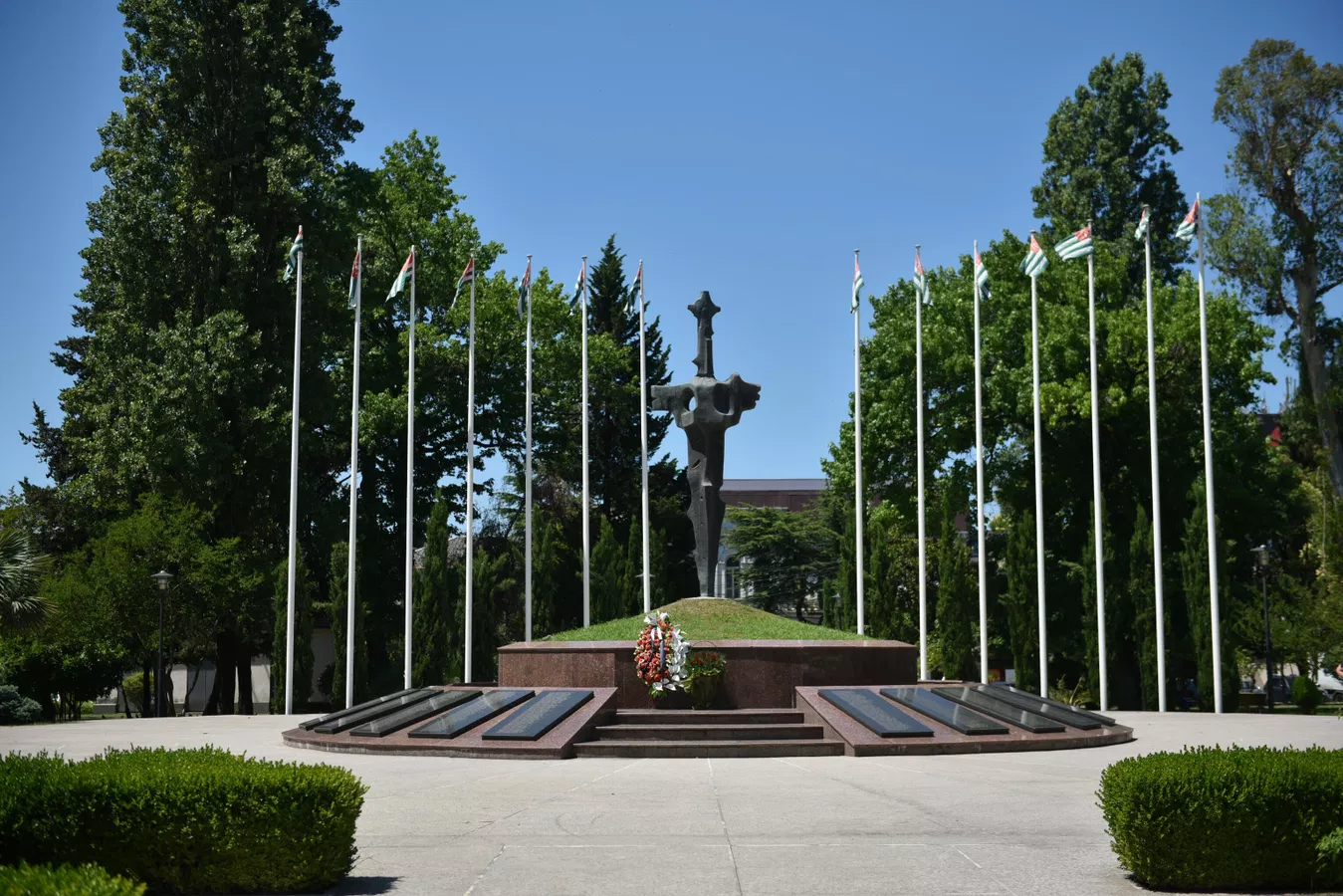
A memorial to the victims still stands today, and the surnames of those militants are engraved on it as well. The Abkhaz also acknowledge that those men were on the helicopter.
In any case, it was a terrible tragedy.
Before this incident, the helicopters would first fly to Sokhumi and then from there to Gudauta. They broke that rule. I cannot remember exactly what happened after this incident… No, there was another incident after that, in the spring as well.
Iago Khvichia: Did this happen before our aircraft started being shot down, or afterward?
Paata Zakareishvili: No, this happened in the final days.
I was supposed to be on one of those aircraft myself. I had brought prisoners down and was supposed to return. I was waiting at the airport for notification of when the aircraft would arrive in Sokhumi. I had already brought the prisoners over and was in Tbilisi. That saved my life. I told the story about Shartava because I was part of his team, and I would probably have died there too. But bringing the prisoners out and evacuating them was essential…
This is also connected to the issue of executions. We could have executed them – what would have been the problem? Because of the prisoners, they gave me an entire aircraft. General Gurgenidze flew in on a Yak-42. Before that, I had been in the village of Pskhu. We dug up the bodies of six of our men there. After Gagra was taken, they had been making their way through the forest when the Abkhaz shot them along the road. They had been buried in Pskhu. Their bodies were brought out. There were six coffins. We seated some of the prisoners on top of the coffins. Another group travelled separately, and I brought some of them myself.
That is how I survived. My prisoners saved my life. It was because of them that I ended up in Tbilisi; otherwise, there was no way I would have made it back to Tbilisi.
Iago Khvichia: You mean Georgian prisoners?
Paata Zakareishvili: No, the Abkhaz! We were supposed to exchange them later, after all. I brought the Abkhaz prisoners to Tbilisi and moved them away from Sokhumi so that we would have people available for a subsequent exchange.
Since the Abkhaz did not know how many hostages we might take during the war…
We did not take hostages. We could have taken hostages in Sokhumi, but we did not stoop to that. We genuinely did not stoop to doing what the Abkhaz were doing in the villages.
There were a great many Abkhaz in Sokhumi. I protected them. They really were being targeted. People would break into their homes and take their apartments away from them. Such incidents did happen.
Iago Khvichia: Georgians?
Paata Zakareishvili: Georgians. Mostly displaced people who had come from Gagra. They were embittered. They would say, “These people took our homes from us, and how can you tolerate that?!” There were some ugly incidents, but that was precisely why I was there, and why this commission existed: to oppose and prevent such things.
For example, there were cases when notices were put up on the doors of Abkhaz apartments [I would take them down, and I still have them preserved to this day]. They would say: “This apartment has been occupied by such-and-such a person” [I won’t name the surname; I know it by heart, but it would be awkward], followed by the name of the battalion. In other words, they were essentially saying: “If you have the guts, come and fight me for it.” You would see notices like that in the stairwells of apartment buildings in Sokhumi.
There is a world of difference between this kind of wrongdoing and executions. They are two different things.
Besides, we were actively fighting against these people. Personally, I stopped ten to fifteen cases of looting. When people called us by telephone, we went straight to the scene. The landline telephone system in Sokhumi worked remarkably well. It continued working until the very last day. I spoke to Misha Kokaia on the telephone on the final day. I called him from Tbilisi, and he answered. That is how well the system was functioning.
As the state representative responsible for protecting human rights on the ground, I faced two major problems. The first was taking prisoners away from the battalions and bringing them together in one place so that they could later be exchanged. The second was the looting of Abkhaz homes. I am not talking about taking hostages, but about looting. People were taking televisions and refrigerators; there was crime and outright pillaging. In dealing with this, both the military police and the army supported me.
There were problems, but we managed to resolve them, more or less. We need to talk about these problems, but not as though there was some kind of…
Iago Khvichia: An agreement was reached in the summer of 1993, but it was violated in September. I’m interested in the circumstances surrounding the signing of that agreement. What happened to the prisoners and hostages under the terms of that agreement? Why did the war resume? What was your state of mind at the time? How much faith did you have in that ceasefire, and what positive and negative consequences followed from it?
Paata Zakareishvili: Throughout the war, I had the feeling that we were losing, and losing again. Shevardnadze constantly created the impression that everything was fine and that the situation would improve. The local Abkhaz government and all the rest of us were caught up in the same mess…
When we slept in the Council of Ministers building, we had what we called the “eleven-chair system.” You know the expression “the twelve chairs”? Well, if you managed to gather eleven chairs, you could sleep comfortably. You would put five chairs together, another five together, and place the eleventh chair under your head. Then you were a happy man. Gabiskiria would always take several of my chairs. I would look into his office and ask, “Have you got any chairs? Put three of them aside for me.” There was a lot of humor, even in those circumstances.
I always had the feeling that Shevardnadze was making mistakes. It wasn’t that he was deceiving us; rather, he had excessive hopes that never came true.
We entered on August 14, and the first ceasefire agreement was signed on September 3. This was the well-known, important Moscow agreement. Yeltsin practically forced Ardzinba to shake hands with Shevardnadze. Under the agreement, this amounted to a de facto victory, but within a month Gagra was captured. We had been deceived!
After that, during the course of the war, there were at least two or three more attempts to sign agreements. Every one of them was subsequently annulled.
On one occasion, an agreement had already been signed when Zhvania found out about it and declared in Parliament that it was unacceptable to us. Shevardnadze backed down and said that he had not signed any agreement at all. But I have that agreement. It bears the signatures.
Iago Khvichia: Did Zhvania talk him out of it? What was his argument?
Paata Zakareishvili: He said, “How can you conduct negotiations behind our backs? What is the point of an agreement now? We are talking about disarmament!”
It is somewhat dishonest of me to say today that we would inevitably have had to do that. But even then, you could sense that sooner or later we would have to withdraw our troops. This was apparent in conversations with Shevardnadze and Kavsadze as well.
When I spoke to Shevardnadze face to face, he always seemed to trust me. He would say, “Well, what can we do?” Whenever I came back from Gudauta, I would bring information about what the Abkhaz were thinking and who thought what. I spoke only with the Abkhaz. I never spoke to the Russians. I would tell him, “This is what Ankvab thinks, this is what Ozgan thinks, and so on.” He would ask me, “Who told you what?” Then he would sometimes add something himself, along the lines of, “Yes, perhaps they have a point,” or something similar. It is difficult to quote someone who has died when you cannot substantiate what you are saying. He was not entirely sure of himself. I saw the same thing in Shartava: he, too, was not completely confident in his own position. Nadareishvili and his team, by contrast, were extremely sure of themselves.
There were two clearly defined groups within the Georgian government of Abkhazia. One group consisted of supporters of Zviad Gamsakhurdia; the other consisted of supporters of Nadareishvili, Tbilisi, and Shevardnadze.
I’ll be honest with you. I was always an opponent of Gamsakhurdia, and to this day many of his supporters dislike me. But Gamsakhurdia’s supporters were more willing to pursue peace and reconciliation. Kim Jachvliani, Kako Gasviani, who had the organization “Lemi,” and others were among them.
Zviad Gamsakhurdia’s supporters were more inclined toward negotiations and maintaining relations, while those supporting Tbilisi and Nadareishvili, so to speak, were more uncompromising in their principles. They placed greater emphasis on taking the offensive and making no concessions. The difference between the two sides was immediately apparent.
Today, however paradoxical it may sound coming from me, I actually got along better with Zviad Gamsakhurdia’s supporters and found more common ground with them than with the supporters of Tbilisi.
Once, if I am not mistaken, General Avto Tskitishvili signed an agreement with the Abkhaz side, but Zhvania sabotaged it. Then there was a second occasion…
Nowadays, many people joke when they talk about “two Russias.” But there really were two Russias. One was the Russian Duma, and the other was Yeltsin. Yeltsin was more supportive of peace and opposed to autonomy movements. The leader of the Duma, meanwhile, was Khasbulatov. He was Chechen and supported autonomy. There was a confrontation between them. That confrontation was confirmed in October, when Yeltsin bombed the Duma. The idea of two Russias was no joke. There really was an internal conflict.
We left Abkhazia at the end of September. We left Sokhumi on the 27th, and three days later Gali was captured.
We completed our withdrawal from Abkhazia on September 30, and five days later, on October 5, Yeltsin bombed the White House. In other words, the confrontation there was extremely intense.
My assumption is that if we had held out for another ten to fifteen days, it is entirely possible that the situation today would be different.
The story of Tskitishvili’s signature fell through. The second episode involved Khasbulatov’s people coming here. They reached an agreement on the withdrawal of troops. Zhvania sabotaged that as well. These were two episodes in the peace negotiations.
Iago Khvichia: When did that second episode take place, the one in which Zhvania sabotaged the agreement?
Paata Zakareishvili: It was in April–May 1993. The final agreement was signed on July 27, in Sochi.
The Moscow Agreement was concluded between Shevardnadze and Yeltsin, and Ardzinba joined it. It was signed at the interstate level on September 3. In Sochi, in July, an agreement had already been signed between Shevardnadze and Ardzinba. That was an agreement at the Georgian-Abkhaz level.
We undertook to withdraw all our troops from Abkhazia. By troops, what was primarily meant was heavy military equipment. I was not involved in those negotiations, but since my area of responsibility was prisoners… The negotiations were taking place in Sochi. Russia’s representative was Shoigu. Shartava and Kavsadze represented our side. I no longer remember who represented the Abkhaz side. Ardzinba did not take part. Sochi, Gudauta, Sokhumi – those were the three cities we travelled between regularly. I had my own area of responsibility: prisoners. Whenever I was given permission, I spoke about prisoners of war and hostages.
The agreement was signed on July 27. That was when I became known throughout Georgia. We kept bringing out prisoners and hostages, and people’s remains were being repatriated. I was on television every day, talking about something every day. That was when people began to feel that peace was possible. It was the end of July; August passed, and in September the attack on Sokhumi began. It came from above.
Iago Khvichia: Was there no indication beforehand that an attack was about to begin?
Paata Zakareishvili: No, there was no indication at all. Later, the Abkhaz tried to attach various explanations and justifications to what had happened.
We withdrew our heavy equipment: all the tanks, howitzers, everything. We were left with nothing but automatic rifles. The Abkhaz, however, moved all their equipment somewhere into the forests and then suddenly launched an attack.
During the March offensive, the Abkhaz had realized that defeating the Georgians and capturing Sokhumi was impossible. Withdrawing this equipment was of fundamental importance to them. That is why we continue to argue with the Abkhaz about it to this day.
All right, deception may be permissible in war; deceiving the enemy for the sake of victory may be justified, and there is no problem with that. Many heroic generals proudly boast that they deceived the enemy, carried out a manoeuvre and achieved their objective. But if we had still possessed our heavy equipment, there is no way you would have captured Sokhumi. That is simply how things were.
I believe this was a mistake made by the politicians, not the military. The military had many problems. I saw that for myself. I practically lived among them. At the so-called lineika – the military formation or assembly point – although it was not part of my duties, I would stand alongside them too.
It was a mistake in political decision-making. Zhvania was nevertheless right to have blocked the agreement twice, because he could see that the situation was unreliable. Almost nobody remembers those two agreements that Zhvania blocked. The events of July 27 had already completely…
Iago Khvichia: So you are saying that our side did not violate its commitments, not even in a way that could have served as a pretext for war. What reason did the Abkhaz use to resume the war? What was Russia’s position in this situation?
Paata Zakareishvili: Russia, in the person of Yeltsin, was officially on our side almost throughout.
Yeltsin and the Russian Foreign Ministry issued very strong statements when the offensive began. They said they found it strange and could not understand what was happening.
At that time, Gamsakhurdia was still in Grozny, making statements from there against Tbilisi and Shevardnadze. The Abkhaz assumed that Gamsakhurdia was joining the war and that the Georgian side was manipulating the situation in some way. But the offensive had already begun by the time Gamsakhurdia returned to Georgia and landed at Senaki Airport. This only made the situation more tense. Ardzinba was then directly accusing us, saying, “You deceived us.” But that was not true.
Iago Khvichia: What connection did Zviad’s arrival have with all of this?
Paata Zakareishvili: This is a complex subject. Ask other people about it on another programme as well.
As soon as he landed in Senaki, he went straight to Zugdidi and then crossed over into Gali. He met with military personnel there. All of this happened in a single day. The Abkhaz believed that we were preparing something.
Iago Khvichia: Had military operations already resumed by that point?
Paata Zakareishvili: Yes.
Iago Khvichia: Then what was the point of blaming us?
Paata Zakareishvili: They needed a pretext, after all.
If I am not mistaken, Zviad returned to Senaki on September 24, and on the 27th we lost Sokhumi.
I do not directly link these events to one another, but this is a detail we need to know. It is something that requires discussion.
The Abkhaz used these events very effectively to substantiate their position. The fact is that they wanted to break the agreement.
Iago Khvichia: So the agreement had already been violated before Zviad arrived.
Paata Zakareishvili: It would be good if Zviad Gamsakhurdia’s supporters could explain clearly why Gamsakhurdia came back. That would help put these questions to rest. These questions are still hanging in the air. The Abkhaz made very effective use of these events.
Iago Khvichia: From a military perspective, what impact could the arrival of one person have had on the front line? And how did the Zviadists react during this period?
Paata Zakareishvili: Rallies were taking place in Zugdidi, while Sokhumi was under attack. Gamsakhurdia went to Gali and Ochamchire and met with military personnel. He was wearing a uniform. There are photographs, videos – everything. These are well-known images showing him meeting with the military.
The Abkhaz were left with the impression that the Georgians were opening a second front. That was not the case. There was internal tension. We remember Shartava’s famous conversation. But when you want to find arguments in such situations, you can always find them. These are matters worth discussing on your programmes.
Iago Khvichia: What happened after the fall of Sokhumi? I am asking for two reasons.
The fall of Sokhumi, and events of this kind in general, result in new prisoners being taken. How were prisoner exchanges handled after the war ended?
The second thing I am interested in is the route people took to flee. We have heard a great deal about the suffering and hardship people endured along that mountain road. Why did that become necessary? Why could it not have been done in a civilized manner? If you have lost the war and still have to flee, why can’t you do so in an orderly, civilized way? This subject could also become a scandal, but there are rumours about looting and many other terrible incidents along that road. People do not talk about it.
I understand that there is a risk of everyone being condemned, but I also understand that not everyone can be guilty. I also do not understand the criticism surrounding the Baramidze case. Journalists, among others, said that this part should have been cut from the programme. I think one of the problems with Georgian journalism is precisely this attitude. In other words, they believe you should decide which of your guest’s statements should be broadcast and which should not. For some reason, they think that is what journalism means.
But I do not claim to be a journalist. I want to collect good sources for future researchers of Georgian history. Naturally, my programme will include different points of view. I cannot agree with everyone, nor do I have to like everyone. So I approach all of this calmly. On the contrary, I want a great many opinions that are prevalent in society to be voiced on the programme, including those concerning the so-called Chuberi Road. It is as though we deliberately avert our eyes from this episode. I want us to investigate it properly.
Why did people have to take that road? And why was the road in the condition it was?
Paata Zakareishvili: This is a painful subject.
There was the Chuberi Road, and there was another route – the coastal road. It ran from Sokhumi along the coast, passing through Dranda, Ochamchire and Gali. It was an excellent road, a proper highway. Tanks and military equipment could have travelled along it.
There were Gamsakhurdia supporters in Zugdidi, and perhaps that was why it was decided…
I know this only as a kind of legend. Just as this question troubles you, it troubles me too. I asked the military: “Why did you do it?”
Iago Khvichia: What reasons were given at the time? What did people say? Why were all these people being sent into the mountains? What was the problem with letting them pass through Zugdidi?
Paata Zakareishvili: Because the army went up through the mountains. Logically, that made sense, because the assumption was that we would have to clash with Gamsakhurdia’s supporters here. They might try to take our weapons away…
It was already known that many people had returned to Zugdidi along the main road. Everyone who had left Ochamchire had taken that route. They did not know the Chuberi Road. After Sokhumi fell, people left Ochamchire and Gali by that road.
Iago Khvichia: Did those people encounter any problems along that route?
Paata Zakareishvili: None at all. The only thing was that they were searched, and if they had weapons, they were made to leave them behind. Everyone was allowed through, but they were questioned: “Did you fight or not?”
Iago Khvichia: Did they mean fighting in the civil war or in Abkhazia?
Paata Zakareishvili: I do not know the details. They were probably asking more specifically about Abkhazia.
Iago Khvichia: Why would they take weapons away from people who had fought in Abkhazia?
Paata Zakareishvili: In short, a number of people – perhaps several – were made to surrender their weapons. The military knew about this. There is a world of difference between being made to leave behind an automatic rifle and being made to leave behind a tank! The civil war was still going on. They were almost going to capture Kutaisi. Those events were continuing. This is another part of the story, one we do not like talking about.
I was arrested in Poti by Zviadists. It is connected to Abkhazia, but it is a different story. After the war, I was travelling by ship to Gudauta to bring prisoners out.
Iago Khvichia: That is interesting. Tell me about that episode.
Paata Zakareishvili: As it happens, Aslan Abashidze helped me then too. He provided me with a ship.
In other words, that route was open. People could have left that way. But the military decided to take the Chuberi route so that they would either avoid a confrontation with the Zviadists or avoid having to hand over their weapons. They had very little heavy equipment. They did not have howitzers either. I think they had two or three armoured personnel carriers, or something of that kind. Mostly, they had heavy trucks. They had their personal weapons. They had plenty of automatic rifles and machine guns.
They went up through the mountains to avoid a clash and to avoid having to surrender their weapons, and so that the war in Abkhazia would not be compounded by a fratricidal war. Their intention was to continue through Svaneti and reach Kutaisi without incident. That was probably their plan, and it probably worked.
But since the entire army went up into the mountains, the civilian population followed them.
This is probably the most difficult and painful question for the military. The military has its own infrastructure and logistical support operations, and in circumstances like these, protecting civilians is also part of its responsibility. I do not think they had evacuation plans. Someone should have been there to say: “You go this way; you go that way.” There was nobody in charge of organizing that.
Once again, we have to turn to the politicians. When a country is at war, its political leadership must also switch into wartime mode, and they are obliged to make sure that all these things are carried out.
In short, the civilian population followed the military in the hope that they would be protected. I agree with you that there were terrible incidents. There was looting, and I think there were several murders as well. I know this only from rumours. But the majority made it out safely.
Iago Khvichia: Between whom did these murders take place? And why did they happen?
Paata Zakareishvili: Again, I know about this only through rumours. They happened when people resisted during looting. “Give me your weapon.” “I won’t give it to you.”
Many people were armed. The men travelling along that route had weapons. They were not soldiers. They were family men, but they had fought. They had defended their yards, their neighbourhoods and their villages, and had been forced to take up arms. They could not leave their weapons at home. They slung them over their shoulders and set off. You cannot hide an automatic rifle. And then people were taking them away along the road – and fellow Georgians, at that. It was a matter of dignity.
But everything I know about this comes from other people’s accounts. That is why it would be better for those who were actually there to speak about it in greater detail. There are countless people who travelled that road. It is such an important subject that an entire programme could be devoted to it.
People froze to death along the way. People died. There were elderly people and people with heart conditions. All sorts of things happened. Dozens of people died. I think I have written this down. More or less everything has been counted.
At the top, helicopters were waiting for them to take them to safety. One helicopter actually crashed. It was a Ukrainian helicopter. There was an accident, and people were killed. That tragedy happened as well.
Everyone who came through from below was searched, had their weapons confiscated and was then allowed to go. There were no problems at all.
After that, the civil war continued throughout Samegrelo. Villages in Samegrelo were captured; Khobi was taken. They moved into Imereti as well, captured Tskaltubo, reached Zestaponi and took Poti.
And it was at this point that my own episode took place.
During this period, Sandro Kavsadze was conducting negotiations in Geneva, while I was organizing a prisoner exchange. After the war, on December 12, we exchanged all the prisoners, everyone for everyone.
Ardzinba had taken civilians hostage – ninety people. They did this just in case, thinking that perhaps the Georgians might take hostages too. Ardzinba took hostage people who had no connection with him. I needed to go to negotiations. Georgia was sealed off. I could not get through. I could not even reach Zugdidi, from where I would then have called Gali. I already knew whom to call, where and how.
Kavsadze told me that he could not call Aslan Abashidze himself. He said I should contact Abashidze through a special channel. He also assigned me another task: the Enguri hydroelectric power station had been shut down. I spoke with Ardzinba too. But that is another episode.
I called Abashidze. “Come to Batumi,” he told me. I went to Batumi and explained the situation to him. He was pleased as well. Later, he even claimed credit for what had happened. He had earned that credit and took it. To this day, people say that Abashidze was the one who freed the prisoners.
I am now telling you how the prisoners were actually released. I went to see Abashidze, and he told me he would provide a ship. He gave us a Kometa, a hydrofoil. It was October, and it was already cold. He sent two of his deputies with me. Both were named Badri. I do not remember their surnames. They were well-known figures, his right-hand men. They are probably in Moscow now. There were also two members of the ship’s crew. We travelled along the coast.
At that time, we knew that Poti had been captured by Gamsakhurdia’s supporters. People were trapped in the port. There was no way out of Poti; it is a dead end. Block the two roads and that is it – Poti is cut off. People had crowded into the port. Gamsakhurdia’s supporters were responsible people. They had all these people in the port, and then, suddenly, a ship appeared. They came rushing out in speedboats, opened fire on us and arrested us. They saw an empty ship. What could have been better than that? “Who are you?” they asked me. “Zakareishvili.” “He’s a putschist!”
Abashidze’s people saved me. His name carried weight. We explained that we were going to Gudauta to bring out prisoners. They realized that this was a serious mission. They knew I had been working on prisoner issues. They let us go, but only after considerable difficulty. By then, it had got dark. We could no longer reach Gudauta in time.
This was the period when Ardzinba had not yet moved to Sokhumi. He was still in Gudauta. All of this happened during that brief interval. He moved to Sokhumi soon afterwards, but until then he remained in Gudauta because it was not safe for him to move to Sokhumi.
As we approached Gudauta, it was getting dark. One or two Russian patrol boats came up to us. There were four or five Russians aboard. “Where are you going?” they asked. They made some calls and checked things, but then told us, “We cannot let you in now. We will let you in tomorrow morning, once the sun has risen.”
Being out at sea at night in October is a nightmare. We froze. None of us had warm clothes. I had never experienced such cold in my life. You cannot sleep or do anything. We had one bottle of vodka. We drank it, but it did not help. Finally, in the morning, we managed to enter Gudauta. Nobody paid any attention to me personally. What mattered to Ardzinba was that two representatives of Aslan Abashidze had arrived.
Iago Khvichia: Did he know Aslan?
Paata Zakareishvili: Yes, and he had a very high opinion of Aslan Abashidze. The two men were received warmly. They laid out a feast for us. There were toasts.
What was the main task? He was holding ninety to ninety-two people hostage. Not one of them was a soldier. “Give them to us,” we said. “What do you need these ninety people for?” I told them that these people needed to be taken home and that the Abkhaz had no objection. “All right,” they said, and they agreed.
Then Abashidze sent an aircraft and flew those people to Batumi. He earned himself some credit. That is genuinely what happened. I have never claimed credit for it myself. I am grateful that those ninety people were not left abandoned and that we managed to bring them out.
That was the episode in which the Zviadists arrested us and then released us.
Iago Khvichia: This raises a question for me. You say that the Zviadists later launched an offensive in this direction and advanced this way. Was there no attempt to say: instead of heading east, let us first fight in the west and hold on to Sokhumi? Perhaps that would have been unrealistic given the circumstances. Maybe it was impossible because the weapons were no longer there; they had been taken away, and relations were so bad that it was impossible to restore cooperation quickly enough to fight together against a common enemy. But was there no attempt to say: instead of going through Svaneti to avoid encountering Zviadist troops behind us, let us talk to those people and see if we can work together? In your opinion, was there no room or context for such a discussion?
Paata Zakareishvili: No, I do not think so. Karkarashvili managed to cross the bridge and bring some units across. I do not remember the details. I am talking about the period when Sokhumi fell. The events we are discussing now took place over two or three days.
It was possible to cross back and forth; it was possible to talk. But I think that at critical moments Gamsakhurdia’s supporters would back down. I do not want to speak superficially about such matters. It would be better for the people who were directly involved to talk about these events. Many people are still around, including officers who took part in the negotiations.
There were definitely attempts to negotiate. This was the case in the context of Loti Kobalia and others as well. There were attempts to put up a united front and resist together, but there are two different versions of the story: “He betrayed us,” and “That one betrayed us.” When the sides accuse each other of betrayal, I have no moral right to justify either of them. Nevertheless, I believe that in a situation like that, Gamsakhurdia’s supporters should have shown greater willingness to cooperate constructively.
I understand their bitterness. There really was a coup d’état, and Zviad Gamsakhurdia really was unjustly overthrown. But as a political scientist, I would put it this way: life has its own rules. When a ship is sinking, it is the captain’s duty to get people into the lifeboats and save them. It is not his duty to say, “It’s not my fault that the ship is sinking; someone shot at us, so good luck to all of you.”
Yes, an injustice was committed, and there really was a coup d’état. It was not legitimate or fair. But when a state is in danger, I think different measures need to be taken. There should have been more cooperation, because Shevardnadze and his supporters were responsible for the state – even if they were not legitimate.
These days, everyone is obsessed with whether something is “legitimate” or “illegitimate.” It is complete nonsense, and to this day I do not understand what people mean by it. Realpolitik exists. So please, deal with realpolitik. Do not simply say that someone is illegitimate and refuse to talk to them. You have to engage in real politics and get to work.
There were negotiations, but they failed. Shevardnadze could not cope with Gamsakhurdia until Russia intervened. Gamsakhurdia’s forces advanced almost as far as Kutaisi. Kutaisi was practically captured, and Yeltsin even mocked Shevardnadze, saying something along the lines of, “Why don’t we divide Georgia down the middle?” Apparently, he said that things had always been this way. There had always been two Georgias: the west and the east.
Iago Khvichia: By that logic, there were more than two.
Paata Zakareishvili: There were two when Russia annexed them. Kartli-Kakheti was separate, and Imereti was separate. That is probably what he meant.
Iago Khvichia: By that logic, Abkhazia was separate too.
Paata Zakareishvili: Abkhazia was not a kingdom; it was attached to Imereti. The Abkhaz recognized the Catholicos of Imereti. It is clear that they had a great deal in common. That is why Russia later created a single province. It incorporated Abkhazia into the Kutaisi Governorate. This is very important. The worst possible outcome would have been for Russia to divide the governorates along the Tskhenistsqali River, creating a separate governorate for Imereti and another for Sokhumi. That would have been the greatest catastrophe.
Iago Khvichia: It does not matter what administrative borders a conquering empire assigns to the territories it has conquered.
Paata Zakareishvili: There were ethnic considerations, and given its own unscrupulous nature, Russia could have done that, but it did not. Fortunately, it did not set off a bomb like that.
To return to our subject: Shevardnadze called Yeltsin, and Yeltsin sent the Black Sea Fleet to Georgia. At the time, Admiral Baltin was in command. There was a joint Ukrainian-Russian fleet then, and Admiral Baltin commanded that joint fleet. Baltin entered Poti and, within two or three days, restored order in western Georgia.
For me, the war ended on March 1, 1994, when we voted in Parliament on joining the CIS. That was when the long-awaited “peace” settled over Georgia. “Russian peace” returned.
Shevardnadze made many mistakes, but this was one of his biggest.
Iago Khvichia: Why? What did that decision change at the time?
Paata Zakareishvili: In the end, we left the CIS anyway, and we lost years. It is like driving somewhere far away, taking the wrong road and having to make a huge detour, losing half a day in the process…
Iago Khvichia: Yes, but if we wanted to do something, how could the CIS have stopped us?
Paata Zakareishvili: It did. Shevardnadze placed his hopes in the CIS. He did a great deal within the CIS.
Shevardnadze was the father of the CIS. As soon as Georgia joined, laws were adopted that made all the member states happy – Ukraine, Kazakhstan, everyone. This was because, under Shevardnadze, laws were adopted on matters such as border protection and mutual recognition of sovereignty. Russia was forced by all the others to respect the sovereignty of the member states. Ukraine was very pleased.
Nobody else dared take steps as bold as the ones Shevardnadze took. But he led us off course. Later, Shevardnadze did return to Europe. He began negotiations with NATO. Shevardnadze first began speaking about NATO membership in 2002, in Prague, and submitted an application for Georgia to join NATO. There was engagement, but all of this came to his mind far too late.
Yeltsin came in February. We signed an agreement on friendship and mutual support, and on March 1 we joined the CIS.
Gia Baramidze resurfaced in this story. Gia Baramidze was the person whose voting console stopped working during the vote on joining the CIS. The votes were tied. Suddenly, Gia Baramidze jumped up. He was shouting, “My vote! My vote hasn’t been counted! The console isn’t working!” In short, Gia Baramidze supported joining the CIS but was unable to cast his vote. He protested, saying his vote had been lost. That was how he made his vote in favour of joining the CIS—with quite a commotion.
Iago Khvichia: Thank you very much for this interesting conversation. I initially had a different idea in mind, but I think this programme should focus exclusively on Abkhazia and the history of Abkhazia, including the history as seen through the eyes of someone who personally witnessed it and was in charge of prisoner exchanges. Reputationally, you are probably one of the people whose account of what happened there carries the greatest weight.
Thank you for being my guest and for providing us with additional explanations in this controversial situation. Is there anything I neglected to ask about – anything you would like to add that would help explain the context we originally set out to explore?
Paata Zakareishvili: I think we have covered everything quite thoroughly. Thank you.
Iago Khvichia: Thank you for this interesting conversation. I think viewers who were somewhat confused by Gia Baramidze’s statements will now have a clearer picture.
Paata Zakareishvili: He did not have malicious intentions, but he hurt a great many people because his assessment was wrong. It hurt me too.