Abkhazia Sokhumi
This text has been prepared on the basis of materials published in Abkhaz media outlets and on social networks. The terms, place names, assessments, and opinions are presented in the form used by the authors of the review materials.
On September 27, Abkhazia marked the 33rd anniversary of the capture of Sukhumi by Abkhaz forces. The city had been under the control of Georgian forces for 407 days, beginning on August 18, 1992. The decisive military operation began on September 16. This day not only changed the course of the fighting but effectively determined the outcome of the entire war: just three days later, on September 30, Abkhaz troops reached the Inguri River.
We offer an overview of Abkhaz media and social networks, examining how the day was marked in Abkhazia and which sentiments and narratives dominated Abkhaz society.
The celebrations brought three key narratives to the fore, permeating the atmosphere throughout these days.
- First, the date was understood as a “celebration with tears in our eyes,” in which the jubilant triumph of liberation was inseparable from profound grief for those who had died.
- Second, the emphasis was on the unbreakable bonds of international brotherhood forged in battle, which united Abkhaz fighters with volunteers from the North Caucasus, Russian cities, and representatives of a wide range of nationalities.
- Finally, a third recurring theme was the passing of the torch of remembrance to the younger generation through sporting, cultural, and military-patriotic activities under the common slogan “Heirs of Victory.”
Official Celebrations: A Bond Between Generations and the Challenges of the Future
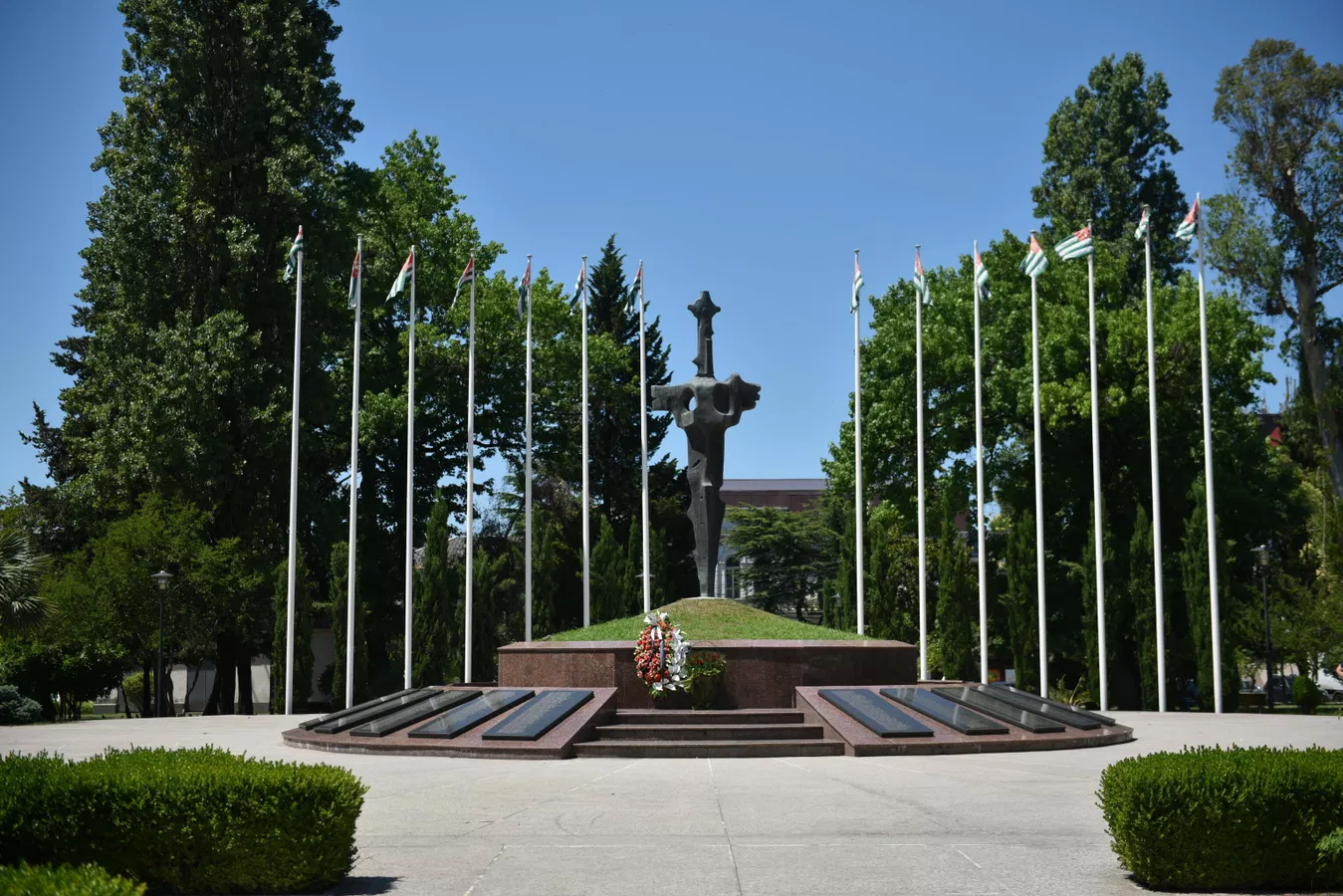
The official program of commemorative events held from September 25 to 28, 2026, brought together formal memorial ceremonies and the vibrant cultural and sporting life of the community. The morning of the commemorative day began with a solemn flower-laying ceremony at Glory Park. Those paying tribute to the fallen included Abkhaz President Badra Gunba, Vice President Beslan Bigvava, Prime Minister Vladimir Delba, Parliamentary Speaker Lasha Ashuba, Russian Ambassador Vyacheslav Gladkov, as well as members of parliament, veterans, and relatives of those killed. Flowers and wreaths were also laid at the memorial on Sukhumi Mountain, where one of the main lines of advance toward the city ran in September 1993.
Badra Gunba’s congratulatory message was published on the presidential website in Abkhaz and Russian: “Thirty-three years ago, thanks to the courage and heroism displayed by our brave defenders of the Fatherland, our capital—our beloved, ancient, and beautiful Sukhumi—was liberated after having been under occupation for more than 13 months.” The president emphasized that the fighters “led by Vladislav Ardzinba were firmly convinced that their hometown would be liberated. Despite the most difficult trials and unsuccessful attempts to liberate Sukhumi, our defenders did not retreat and never lost faith in Victory.”
A restored memorial to the “Defenders of Abkhazia” was unveiled at the Gumista Bridge. According to Levan Chkheidze, head of the village of Gumista (formerly Tsugurovka), the memorial “was originally created by the parents of the fallen fighters themselves—they put it together and brought photographs.” The restoration was carried out at the initiative of local residents with support from Russia’s Presidential Grants Foundation. At the opening ceremony, Alkhas Chitanava, head of the Sukhumi District administration, said: “I wish that the history of all peoples would never include events that speak of such numerous casualties.”
The inscription on the memorial appears in two languages: “Хашҭра рықәымзааит Аҧсны афырхәцәа! Eternal glory to the heroes of Abkhazia!”
The city leadership paid tribute to the fallen at the memorial on Sukhumi Mountain, the route along which forces advanced toward the city in September 1993. Timur Agrba, head of the city administration, said: “Sukhumi Liberation Day is not only a day of mourning but also a day of pride. We will always remember those who laid down their lives to liberate our city, our homeland.”
The political party Amtsakhara called September 27 “one of the most significant dates in the history of our state.” Its congratulatory statement read: “The First President and Commander-in-Chief, Vladislav Grigoryevich Ardzinba, played an exceptional and decisive role in this historic battle and throughout the entire war of liberation.” Regarding the volunteers, the party wrote: “This unbreakable brotherhood of volunteers became a symbol of true solidarity.” The statement concluded: “September 27, 1993, is a day marking the triumph of justice, courage, and the indomitable will of our people.”
The cultural and sporting components of the celebrations were distinguished by their diversity and profound symbolism.
A theatrical performance entitled “The City That Waited,” based on works by Avtandil Gartskia, Ekaterina Bebia, and Nikolai Khashig, took place at the State Philharmonic. A documentary film about Appolon Gurgulia was screened at Abkhaz State University. An obstacle-course race called “The Strength of Abkhazia” took place in the streets of Sukhumi, alongside gatherings of participants in the international 3×3 basketball tournament held in memory of Sergei Bagapsh and the “Heirs of Victory” procession. Meanwhile, veterans of the Eastern and Western fronts faced one another on the football field.
Living Memory: Frontline Chronicles Through Veterans’ Recollections
While the official events provided the celebrations with a formal state framework, publications on social networks and interviews with veterans presented the story of Sukhumi’s liberation in all its drama, filled with genuine human emotions and informal, personal details.
Hero of Abkhazia Aslan Kobakhia published a series of memoir-style essays on his Facebook page. Kobakhia noted: “Nobody gave us Freedom as a gift. We won it at the cost of the lives and health of the finest sons and daughters of our people, our glorious volunteers.”
Other posts in the series focused on frontline episodes and the people involved. In a post about the first banquet held to celebrate Victory, Kobakhia described how a volunteer from Chechnya, Alkhazur Suleimanov, and the commander of the Armenian battalion, Galust Trapizonyan, danced the lezginka: “Two glorious warriors are dancing on one leg, because they left their other legs on the battlefield. The entire hall is on its feet, and tears are in the eyes of the great Vladislav!!!”
A separate post was devoted to Deputy Minister of Defense Mukhamed Kilba, who, together with Sosnaliev and Dbar, developed the plan to liberate Sukhumi: “They never became office-bound officials; they were real field commanders.”
In media interviews, participants in the fighting shared details of the assault and everyday life at the front. Rismag Adzhindzhal, a member of the “Teacher” unit, admitted that at first he could not believe the news that Sukhumi had fallen. When he met the fighters at the Kodori Bridge, he experienced an indescribable happiness at being able to embrace them alive.
Aslan Abaev, a volunteer from the North Caucasus, took part in the fighting for the building of the Council of Ministers. He clarified the details of the assault on the government building: the flag was raised not on the roof of the building engulfed in flames, but on its left wing. Speaking about his motivation, Abaev expressed the essence of brotherly duty in the simplest terms: “We were brought up to believe that the Abkhaz are our brothers. And if a brother gets into trouble, you have to help him.”
The official ceremonies, together with the recollections of veterans and other prominent figures about the wartime period, demonstrate that September 27 carries profound symbolic significance for the Abkhaz people. The emphasis was on unity, an unbreakable spirit, and the fighting character of the Abkhaz people. Such sentiments and narratives dominated Abkhaz society.