







Vision for the unification of Georgia
In August 2026, a public discussion surrounding the conflict in Abkhazia began in Georgian political circles. The process was triggered by an interview with the leader of the Akhali party, Nika Gvaramia. He linked the idea of returning Abkhazia to Georgia’s accession to the European Union and the prospects of the Middle Corridor trade route. However, the cause of criticism and debate was the conversation about war trauma. According to Gvaramia, war trauma impedes the development of society. He cited Karabakh as an analogy.
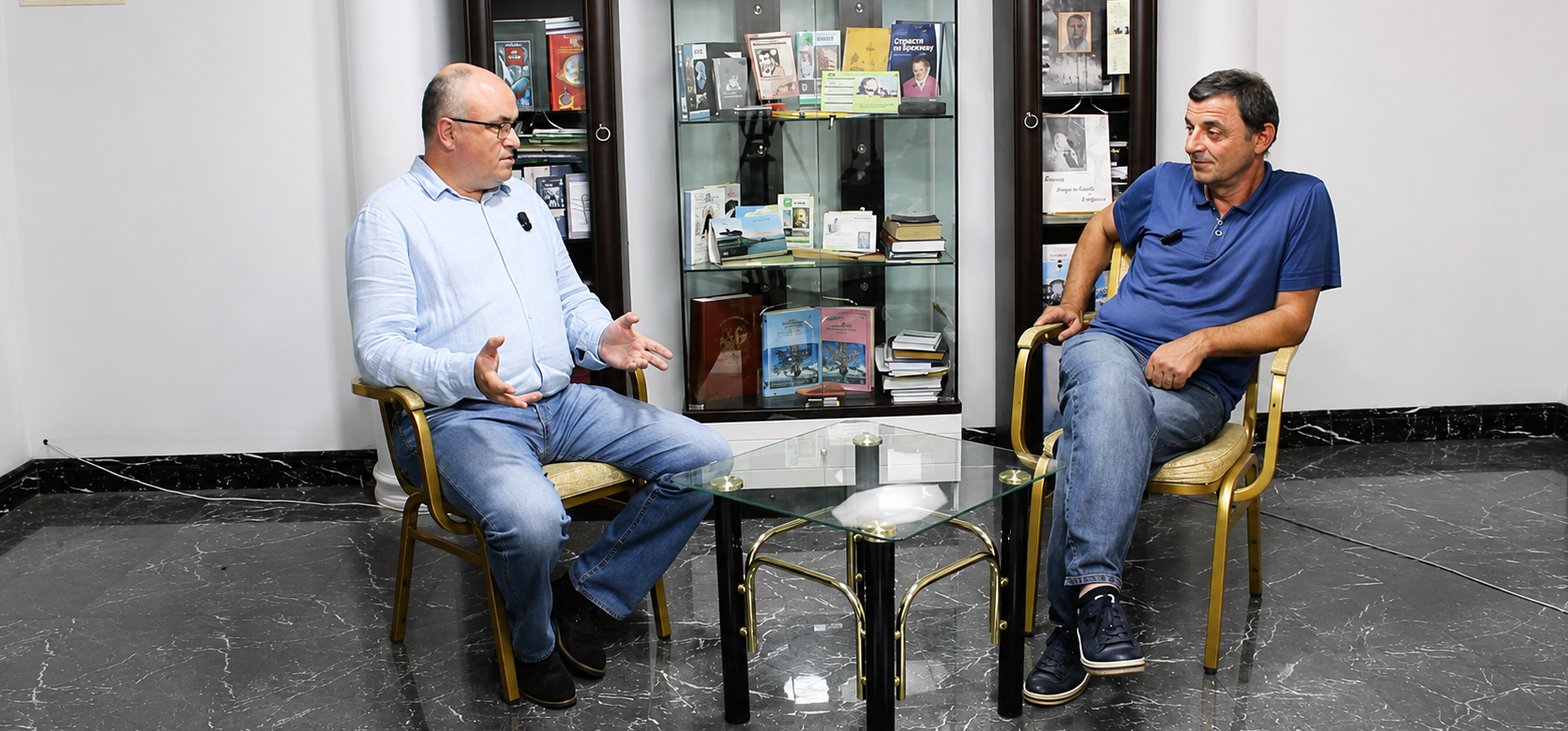
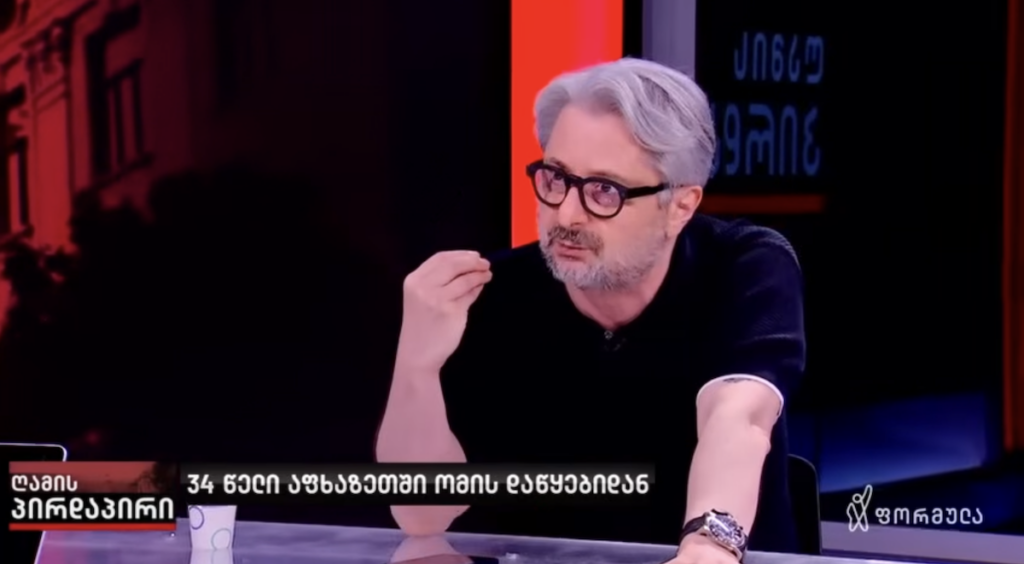
We offer you a series of materials compiling important interviews and statements. In the first part, we present the text version of Nika Gvaramia’s interview. The interview aired on TV Formula on August 15 on Irakli Kiknavelidze’s program.
Irakli Kiknavelidze: These days, I really wanted us to have an in-depth conversation on the topic of Abkhazia. I do not believe there is a Georgian politician who does not think about this or who does not dream about how he will solve this problem. I believe there are prominent politicians for whom thinking about this is part of everyday life. It seems to me that you are precisely such a person, because you are from Sokhumi.
Nika Gvaramia: From School No. 6.
Irakli Kiknavelidze: It has been 34 years since the start of that war. First of all, I want to ask you about this. These 34 years were filled with many things, and how would you recall this entire period? What is your personal memory?
Nika Gvaramia: I can say that I have lived in Tbilisi twice as long as I lived in Sokhumi. I was 16 years old when I left there. Probably every person has a sense of “my city” or “my village.” For me, my city is Sokhumi. Sometimes I notice that I forget certain things: how to get somewhere, where this was, where that was. 34 years have already passed.
It seems to me this is a case where the loss of the Georgian state is much greater than all similar mines that exploded in the post-Soviet space. For example, Karabakh. The status quo ante bellum was restored there. Or even Transnistria and Crimea for Ukraine. Abkhazia is much more than everything else listed.
By the way, the 2008 war personally taught me that from a strategic point of view, the territory of Samachablo, which is much smaller and has significantly fewer development prospects [for an obvious reason—there we are talking about the coastline, and here about an enclave, a territory between the Caucasus Mountains and Central Georgia]—despite this, strategically this region can be much more dangerous.
In addition to the threat of destabilization, the main problem that practically decided the outcome of the 2008 war not in our favor was that Georgia turned out to be practically cut in half. During the war, Western Georgia was practically cut off from Eastern Georgia. This could not be done from Abkhazia. From Samachablo, it could be done.
There is a feeling that these two big problems have practically merged. It was not like that before. Before the 2008 war, it was not like that. Before that, Abkhazia was one thing, Samachablo another. Both problems had different dynamics. And perception was different. For me, this [Samachablo] was not emotionally painful. The perception of Abkhazia stood much higher for me. This old approach was wrong. Purely from a pragmatic point of view, it also turned out to be absolutely incorrect.
Abkhazia for me is my homeland. Georgia is my homeland, but in a more local sense, Abkhazia is my homeland. I think about this both as a son of this country and as a person claiming to be able to do something in politics. Before that, I had other types of public activity.
Irakli Kiknavelidze: You mentioned memory associated with Sokhumi. This is a certain image. An image of a city, a place. Does this image prevent you from seeing today’s Abkhazia as it is?
Nika Gvaramia: No, it does not prevent me, but it came to me with great difficulty. Out of these 34 years, for 26–27 years, if not more, it was indeed so.
Previously, my thoughts were built to a greater extent on emotions, on righteous anger, on historical grievances; I think they were built on the heaviest traumas.
My neighbors were killed and buried in their own yards. This is not even worth talking about compared to what was happening there.
In the prosecutor’s office, I interrogated people. That woman who was forced to swallow her own son’s eye—we interrogated her first. I conducted this interrogation, and for me it was so hard to me that I could not continue and asked my staff to continue the interrogation. This process continued for several weeks. Then a small collection came out, made more in a journalistic style. There are very many testimonies, and publishing them in full might have been less interesting for the reader.
There were such unbelievable things there that for a person who is from there, who carries that memory within, lives by it, it cannot fail to cause a biased attitude.
But a few years ago, I realized that it could not continue like this. And in general regarding traumas, I believe that this will not do. Historical memory is important, but traumatic memory carries danger within itself. It acts like an anchor—it does not let you move forward, it blocks development.
I admire Pashinyan, because the main thing he did [I have seen politicians with much greater capabilities, and indeed in Armenia little is happening in terms of reforms]—is the victory over traumas. He did it in a short timeframe, which is actually a very difficult task. Decades are required for this, because traumas are processed over centuries. He did it in the shortest possible timeframe.
He removed Mount Ararat from the seal. He said that Ararat is part of our history, but not part of our geography. If we want problems with Turkey, then let Ararat be depicted on the seal, but we will be poor and tied to Russia. If we do not want this, then let us agree—we will remove this Ararat from the stamp, which is indeed not on our territory, relations with Turkey and Azerbaijan will improve, we will have more money, the prospect of moving toward the European Union, and we will no longer be with Russia.
He did the same and an even heavier thing regarding Karabakh. After all, Karabakh was truly a surrender. There was a war, but ultimately Armenia said: “take it away from me,” “take” Karabakh.
It was indeed theirs, the Azerbaijanis’. If we talk about historical Karabakh, then we Georgians can similarly argue with Armenians over Lori. That is not the main thing.
Irakli Kiknavelidze: Everyone speaks about what the borders were like when the Soviet Union collapsed.
Nika Gvaramia: I have quite a few friends among Armenian politicians. Probably about 10 years ago, we communicated, and they did not even want to hear about this Karabakh.
They said that Karabakh, firstly, tied Armenia to Russia. In our country, Shevardnadze tried to turn Abkhazia into a sort of gray zone with Russia and would have been content for it to remain with Russia. Shevardnadze ultimately did not make this choice after all.
If we had acted like Armenia, we would have a similar situation here. It is simply that the Abkhazians made this choice, and therefore they are there on the spot, not us.
These Armenian politicians said that this Karabakh, firstly, tied us to Russia and deprived us of a chance for development. In reality, Armenia was the same as Abkhazia [in terms of relations with Russia]; one simply needs to be honest and admit that there were more capable people in Armenia. In the end, we are talking about a great civilization. In no way inferior to Georgia. This is a country of the greatest culture and the first Christian nation. By the way, major shifts occurred from the church’s side in Armenia as well.
Armenia’s problem was that the Karabakh clan was sitting on its neck. This group had political influence. This clan made money on this as well. These are the ones who are now billionaires. Even Bidzina Ivanishvili leaves a better impression than Tsarukyan. These people are all natives of Karabakh. People who grew rich on black money, drug trafficking, and arms trading. Pashinyan cut off this circle too.
Let no one misunderstand the parallel between Abkhazia and Karabakh. Abkhazia is our territory by universal recognition, while Karabakh was not the territory of Armenia. For as long as modern attributes of states have existed, Karabakh was never part of Armenia. It is simply that Armenians lived there. This happened in the 19th century and during the Soviet period.
Pashinyan was not afraid and struck a blow against the church as well. Unlike us, several churches exist there. Specifically, two catholicosates were fully tied to Russia.
We must understand that the second catholicosate, which is located in Jerusalem, is much more influential. It is more influential than the Georgian Church or any other Orthodox church. In Jerusalem there are four quarters: Arab, Catholic, Greek, and Armenian. The Armenians have this history, a history of immense scale. A history of their spheres of interest, trade routes, and statehood. When Armenia was at the peak of its greatness, it was significantly larger than many other states in this region.
Irakli Kiknavelidze: They were captive to the idea of Greater Armenia.
Nika Gvaramia: They had the prerequisites for this. This is a people with a great history. We too are captive, captive to the idea of “from Nikopsia to Daruband.” I will return to this idea, because I believe that right now we can realize this idea—not physically, but geopolitically. I will return to this.
We too have our traumas, but our traumas formed differently. “Georgian Dream” formed them. We translated these traumas into fear of war. Not into the idea that these are our territories, they were taken from us, we move forward with this trauma and will not forgive the Abkhaz. That is bad; that was happening to me. I mean the idea that one should not talk to the Abkhaz, one must enter and finish this. That existed. Now it does not.
The bad thing “Georgian Dream” did is that this trauma was translated not into something that—I repeat—is not good for a nation, but at least understandable, normal, and leaves some kind of chance, namely: “this is mine and I will fight to the end.” Instead, this trauma was translated into “I do not want war,” “anything as long as there is no war.” This idea was born of the same trauma.
Let us be honest. Our people have seen war. Most recently in 2008. Unlike the 1990s, we all saw what happened in 2008. What was happening in Abkhazia, no one saw. Someone might have seen some documentary footage later on, but in 2008 we saw every minute what was happening. We saw bombed-out Gori, dead people on the streets; bombs were falling in Tbilisi as well.
Capitalizing on these traumas is terrorism. When the authorities constantly whisper Memento mori in people’s ears, remember death—this is terrorism against one’s own population. Instead of making people forget, one must not stoke the heaviest fears in people on a daily basis.
I find it laughable when they say they cooperate with the Abkhaz by supplying gasoline. They do not care about Abkhazia or the Abkhaz. What kind of cooperation with Georgians can we talk about when Georgians have closed the topics of Abkhazia and Samachablo altogether? But after all, this did not happen because Georgians came to terms with the loss of Abkhazia, did it? No. Georgians have not come to terms with this.
This happened because “Georgian Dream” converted the trauma of war into fear and tells them: “Ah, you want Abkhazia back? Then there will be war. Or you must become part of Russia and unite with Abkhazia there.” In reality, they left these two choices. And a Georgian wants to be neither part of Russia nor at war. The fact that he does not want war—this is understandable to me.
We must know the people, our nation, as they are. We must accept them as they are. If we are politicians and want to work with these people, we must know that they care about Abkhazia, but they do not want war. We are talking about the overwhelming majority of people. Understandably, for a certain number of people, hearts still flutter because of many things, they are ready, and so on.
First of all, no one knows where this readiness will lead, and secondly—we speak on behalf of the people. And the people do not want war. That is a fact. Nothing can be done about this. The new generations all the more so. They do not understand at all why even what is happening is worth war. This generation has been raised to be very pacifist. Whether you want to accept this reality or not—it is so.
That is precisely why we must seek a way out that is simultaneously a real solution, not empty texts; but at the same time, we must know that war cannot be a way out due to the desire of the people, and at this moment cannot be a way out simply because we have no resources for it.
We have a legitimate right to restore our territorial integrity. I do not question this. But when you enter there, and as a result of the current state of your army [what “Georgian Dream” has done], the Abkhaz will not reach Kutaisi—how do we know this? Emotionally waving a flag is in most cases irresponsibility.
Irakli Kiknavelidze: Political irresponsibility brings great harm. Nika, you mentioned that a Georgian wants to return Abkhazia. But there is one question we do not talk about out loud. You mentioned the youth as well. Emotional distancing occurs, as does an emotional bond. For example, when I watch them dancing with assault rifles slung over them, who knows who they are, there is bitterness in these frames. And this bitterness is passed down from generation to generation. It is the bitterness of defeat. But I have met many people who do not say this is good, but look at it as a given and say it is a given that we will not be able to return Abkhazia. They ask: what will make Russia to pull out of there?
Nika Gvaramia: I do not believe in that.
Irakli Kiknavelidze: I do not believe in it either, but part of our society does not speak about this out loud. They do not speak because they do not want this to happen. Perhaps they are not open to conversations on these topics. What would you say to these people?
Nika Gvaramia: I understand these people. These people look at the mainstream narrative that Abkhazia can only be returned through war. If you look at this issue critically, not only in terms of desires [what people want], but also in terms of assessment [can you do it], then a quite real and natural conclusion is that we will not be able to return Abkhazia. I understand, there is a rational sense in this too.
I look at it differently. We must talk a lot about how we imagine the unification of Georgia so that there is no war, and at the same time the unification is real, not a prospect of the distant future.
If we lose Abkhazia in memory—that is what the actual loss of territory is. Memory belongs not only to me and you. Memory belongs to the next generations. My child will not lose this memory, because I often talk about this. This is my reality, because I care about this, I am from there, my relatives are from there, my circle talks about this, and that is understandable.
Irakli Kiknavelidze: My child will not be able to lose it either. My wife is from Sokhumi. This connection is important.
Nika Gvaramia: But the question is—how? This way out exists. So we have returned to the idea of “from Nikopsia to Daruband.” Nikopsia is Abkhazia…
Irakli Kiknavelidze: Who will return to you in peace what was lost in war?
Nika Gvaramia: No one will return anything to you.
When will the people living in Abkhazia and Samachablo return? When it is interesting to them and they live better. Can they live better together in a single Georgian state [a state of Abkhazians and Georgians]? They can!
This is connected to the European Union, to Georgia’s membership in the European Union. I am absolutely convinced that in a situation where Russia will be destroyed, after the war with Ukraine, they will not only be unable to move freely, they will not be able to leave their country at all…
And the Abkhaz are not a people who are in love with Russians. And they never were. There is a rational explanation for this: Russians consider them third-rate people. They do not consider Georgians so, but them—they do. The Abkhazians feel this very well. They dislike Russians very much. Very, very much. And if you look, the Abkhazians do not lie down under the Russians. On the contrary, even more aggressive outbursts occur.
Irakli Kiknavelidze: Although they might dislike Georgians even more.
Nika Gvaramia: Understandably, this is a post-war situation. We do not love them either. We lie when we say “brothers” and so on. We do not love them; we cannot love people who killed our neighbors. We must think about being pragmatically useful to each other at this very moment.
Why might we be useful to each other? It is a Georgia—a member of the European Union that appeals to Abkhazia because it has free movement, a European passport, a free and developed economy oriented toward national minorities. A guarantor will appear there. Not blue helmets and Russians [how can Russians be peacekeepers when Russia is the main party in this war?], but an institutional guarantee will appear for the Abkhazians that they will live in peace.
We too must know that if we want our jurisdiction to extend over this territory again, we will in any case have to make certain concessions. But on the condition of membership in the European Union and a state named Georgia, with its constitutional coverage of Abkhazia.
Why do the Abkhaz need this? First of all, money. The European Union will spend huge amounts of money on the restoration of Abkhazia. And this is advantageous to us too.
I said somewhere that billions and trillions will be spent in Ukraine, and we will not be there. The next day I saw comments saying, “he wants to make money on the blood of Ukrainians.” Specific oppositional politicians said how he can think of such things right now. How should I not think about it? If a Georgian politician does not think about Georgians earning a lot of money on the reconstruction of Ukraine, then such a politician as a citizen is an ordinary fool, and as a politician—is nothing at all.
By the way, Abkhaz love money too. And in this case, to put it slightly cynically, for us this is a useful thing. How can this fail to interest the Abkhaz, at least as an opportunity to earn money individually? As well as for their country, what they call their country, for its restoration.
Abkhazia is a unique territory that currently represents ruins, ruins of civilization. I can say the same about the population of Samachablo. I do not want to miss this. Talking about Abkhazia, I am talking about my home.
Irakli Kiknavelidze: Besides, the specifics of Abkhazia are different. By the number of people, the scale is also different. In Samachablo, we are mainly talking about one Russian base and the people employed there.
Nika Gvaramia: Yes. The main story is again “from Nikopsia to Daruband.” Nikopsia is Tuapse. Without Abkhazia, “from Nikopsia to Daruband” does not work. What Daruband is, I will say later.
The point of attraction for Abkhazia should be what in Saakashvili’s time was called Lazika, and now is called Anaklia, and which is the main center of gravity in Georgia that interests the world. Sometimes it seems to me that even those people who realize well how important Anaklia is, even they do not understand this to the end.
My main story, to tell you directly, is membership in the European Union and “snatching” the Middle Corridor. I say this word directly. We must snatch this.
The duty of this generation is to grab the main new trade route. This is the Middle Corridor. The trade route from Central Asia to the Black Sea. The Black Sea is the gateway to Europe. That is absolutely, certainly so.
The European Union and the United States of America have stated that this is a strategic sea, and a sea cannot be strategic for you if you control only the western shore.
On the southern shore there are problems and weaknesses; Turkey is there, and Turkey for now remains a problematic country for Europe [I suspect this will be for a long time], and in the north—Russia. Also Ukraine, where a war is going on now.
Even if you look purely geographically, the eastern coast of the Black Sea and Georgia are even more important. Why? Because this is the key to Transcaspian countries, countries of the Caspian basin. And this is not Azerbaijan and its oil in first, or very soon even in second place. It is Turkmenistan with its gas and oil, Iran with its gas and oil, but what is most important, rich in rare minerals and new-type oil Kazakhstan and Uzbekistan. Afghanistan and Mongolia are among them too.
This region is coming alive. The West will begin extraction of these riches. This process is ongoing now as well, but they cannot even sell because they have no road. On one side is Iran, on the other side—China, which is itself the largest supplier and does not need a competitor in the form of Central Asia at all. And on the third side—Russia, which will not let any cargo pass without buying it up itself and reselling it at a higher price. It does so with gas, wheat, with all products.
So the territory from Nikopsia to Daruband, in this case from Daruband to Nikopsia, is critically important. This is the main part of the Middle Corridor. This is Europe’s key to the market where they must enter with all their might to simultaneously replace China and Russia. Central Asia, together with Mongolia and Afghanistan, indeed has the potential to do this both for the Far East [for Korea and Japan] and for Europe, Great Britain, and America.
It infuriates me that this line today passes through Georgia. The line of the new world economic order. This has the greatest impact on geopolitics. Such is the history of the world. New economic orders always shape new geopolitical maps, spheres of influence, and pictures.
In this situation, as soon as we have influence from Nikopsia…
We must stand there and have built at least a port, which should interest the Abkhaz as a zone of gravity; which will have a twin port in Ochamchire, because in another place it is impossible. Ochamchire port does not have great depth, but it can accommodate that part of the vessels that can enter the port of Poti and Ochamchire. [In Supsa/Kulevi, if I am not mistaken, the shore is deep too]. And Anaklia must accommodate the largest vessels.
Why are large vessels important? If vessels with large displacement do not enter, it is impossible to talk about large cargo turnover. But if they enter, and this in parallel will be an American-European-British consortium [owned by the state of Georgia, but under their management for a century]…
Irakli Kiknavelidze: Where these cargoes should be sent, to those who need them.
Nika Gvaramia: It will belong to those who carry these cargoes. The Turks do not carry these cargoes, and even if they did, to reach Kazakhstan, the Turks do not need the Black Sea. Their cargo will somehow get there by another route. If this port [Anaklia] is built by Americans and Europeans, where will they pass their cargoes? After all, they will pass them through their own port. They will not carry them through Zangezur, on the adjacent territory of which [in Iran] a war is currently going on. I will tell you honestly, for me Zangezur is an unpromising project. If there is a war in Iran, Zangezur is a danger zone, and if there is no war—who needs Zangezur?
Irakli Kiknavelidze: If supporters of “Georgian Dream” were listening to you, they would say that our government says this too. Besides us, they have no other way. They will still have to negotiate with Bidzina. What would you answer to this question?
Nika Gvaramia: Everything is very simple. How do you mean they don’t? They will go through Turkey.
Irakli Kiknavelidze: The emphasis on geography, that besides us they have no other way.
Nika Gvaramia: This path works when the port of Anaklia… and including this, it is a path to territorial integrity. I look at these two things. This is the path to Georgia’s future. This is the shortest path to territorial integrity, the shortest path to wealth, and the shortest path to security. This is not simply the shortest path between Asia and Europe. For Georgia, these are simultaneously three paths.
If it is a British-American or European port… There is nothing that the Western world protects as it protects private property. Not treaties, nor promises regarding defense, nor the charter of any alliance. No! Property is what any Western society protects most of all, because it is a society ideologically built on property. That is the first thing.
Second: it is excluded that this path would work without democracy. Highest-quality logistics must be on this path. Added to this port is the renewal of the railway, for which we have no money—neither for the railway nor for the port. Where everything is managed by one person and there is no court, it is excluded that such a project will materialize.
How do you imagine all this passing through here while Bidzina Ivanishvili simply sits and watches? How many things will he interfere in, if not everything? Imagine if later an investor has some dispute and Murusidze considers this dispute. How do you imagine that?
Irakli Kiknavelidze: The route of the Middle Corridor must pass through many countries. There are no uniform tariffs…
Nika Gvaramia: There are not many countries. From Kazakhstan, from the port of Aktau, there are only Azerbaijan and Georgia. That is the whole essence. This simplifies this route. It seems that land communication is easier, but that is not so. The sea is faster and shortens distance.
Imagine, when cargo from Anaklia arrives in Constanța, that’s it—it is already in Europe. Now imagine that Anaklia is also European Union territory. And if we are in the European Union—it will not be Georgia speaking with Azerbaijan, but the European Union. The European Union will speak through the voice of Georgia.
Georgia becomes the main speaker in the main economic project of the first half of the 21st century. Imagine what wealth this is for every Georgian.
If Bidzina Ivanishvili remains, this wealth will be for him. Therefore, they will do nothing with him. They will travel through Turkey, which is not a comfortable partner, is a corrupt country. Its logistics are definitely not the best, because this country is not yet of European quality.
The advantage of Georgians is that they are clearly a European people. Whatever happens, so it will be. Russia will exert influence?—Still a European people. Some oligarch announces an exit from Europe?—Still a European people. A “Georgian Dream” voter who votes for Bidzina—still European. That is the difference. This country has the prospect of democracy. Azerbaijan does not have this prospect. That is the choice of those people.
Irakli Kiknavelidze: So we offer this to the Abkhaz?
Nika Gvaramia: We offer the Abkhaz a good life. And there is no Abkhaz who will refuse a good life.
Only we offer this not at the cost of them being somewhere in second roles. They must be a full-fledged citizens of Georgia.
Our getting used to each other will be a difficult and lengthy period. Our next generations will love each other again. Our generations—no.
The first stage of the development of these relations, probably for 20–30 years, will stem from mutual necessity. This is not impossible. Mutual necessity is called mutually useful economic relations. This is realistic.
Irakli Kiknavelidze: I want to ask you as a legal scholar as well. When we talk about reconciliation, there are several options. There are very bad models, like the one in Lebanon that ended in complete disaster. By the way, in Abkhazia in the 1990s, the same thing was happening—ethnic distribution of posts. There is the Bosnian model, which is not successful.
Nika Gvaramia: Bosnia is the fault of the West.
Irakli Kiknavelidze: There is the Good Friday Agreement in Ireland. There is the example of Cyprus in terms of freezing the conflict.
Nika Gvaramia: In Cyprus, a solution was found; simply for reasons incomprehensible to me, the Cypriots themselves refused. The Turkish population agreed to joint accession to the European Union without restitution, without return of property or compensation. I do not remember exactly whether property could be returned, but South Cyprus refused this.
Irakli Kiknavelidze: Then in that respect a huge chance was missed.
Nika Gvaramia: I am not saying that in Abkhazia there should be no return of refugees and that we should refuse the return of property. I am a refugee myself. But there will be things in which we will have to concede. On that side, they too will have to concede. Without concessions, merging will not happen. That is excluded.
Irakli Kiknavelidze: By the way, according to Shevardnadze’s own account, when Ardzinba was brought at one time, they demanded that there be a Constitution of Georgia, a Constitution of Abkhazia, and then a common Constitution, a constituent act. Shevardnadze refused this. Is this acceptable or not?
Nika Gvaramia: I do not know the origins of that scheme. Once again I say that membership in the European Union from a legal or procedural point of view provides very many opportunities.
We will not be able to come out and say that under a new treaty we are founding our state anew. That does not happen. We are a country recognized by international law within these borders. In this respect, we have nothing to ask from anyone. The issue is closed. But the fact is that we cannot exercise full control over this territory. What starting platform for this process should be such that it is not painful for us, nor does it become something specific for them?
Irakli Kiknavelidze: The European Union is a basic sense of security.
Nika Gvaramia: I am thinking out loud right now. Upon accession to the European Union on behalf of Georgia, together with Georgia, a representative of the Abkhaz side and a representative of Samachablo can… I am saying such a thing for the first time now, and in general politicians do not like to talk about this.
For me the task is only one thing: so that my grandchild does not forget Abkhazia. It is excluded that we would do so little that our grandchildren will not remember Abkhazia.
Irakli Kiknavelidze: We, unfortunately, are not Armenians and not Jews. They have other levers of memory.
Nika Gvaramia: You know what, perhaps it is not unfortunately. A nation has its national traits. Georgia reached today thanks to its own character, national traits, including national flexibility.
They say that in Georgia there should not have been ethnonationalism and that the path of the Baltic states should have been chosen. Forgive me, but this country had no experience of civic nationalism. In the dissolution of the Soviet Union, Georgia played a role no smaller than the Baltic states.
Whatever characteristic trait it had, with the help of that the country emerged from the Soviet Union. To climb up, one must push off from something with one’s feet, right? And that from which to push off [civic society] was absent, so what was there to push off from? It found a focal point in the form of nationalism, pushed off, and went forward. Ahead of you are entire centuries to work independently so that civic equality and patriotism are equal. But what memory did they have back then…
That is precisely why Mamardashvili was not a symbol for Georgians and never will be. Because back then there was Zviad Gamsakhurdia; he felt the pulse of his nation. And this man [Mamardashvili] did not feel the pulse of his nation and was for Georgians neither great, nor average, nor anything at all.
Irakli Kiknavelidze: By the way, about the character of Georgians, about this uninhibitedness, Mamardashvili wrote best and captured these details precisely.
Nika Gvaramia: What did Mamardashvili say that we should have believed or not believed? If you placed Derrida next to him [by the way, in terms of time the difference was small, in terms of scale—there was], if Derrida looked from the side, he would have written the same thing about Georgians.
For a person looking from the standpoint of universal human ideals, it was not difficult to write about what Georgians were doing wrong. What was difficult was what Gamsakhurdia did. He found a focal point and brought independence to this nation. That was what was difficult.
Irakli Kiknavelidze: This energy now needs to be reawakened. These embers are alive…
Nika Gvaramia: I do not look at it that way. When they say about something that it is alive, there is a suspicion that it might be dead. This is not subject to doubt at all.
It is not just alive—we have a normal situation. We have a few specific problems. Including such a trivial one as the lack of money. We observe poverty not only in society, but also in the political spectrum and civil society. Let no one say that this problem has no impact. It does have an impact.
We have such a problem as fatigue. We have such a problem as forced information in the form of propaganda, but not because we believe in something. Messages like “otherwise you want war? ” have exhausted themselves. Propaganda works on us most strongly by draining our energy.
When they say that a woman grew a third breast—clearly this is nonsense, and society will talk about it all day. Why? Because nonsense has always attracted attention. Especially this kind. After all, this is not deep; it is superficial. But this superficiality causes a lot of talk, shouting, and screaming. Someone will appear and say that a third breast can exist; another will say that it cannot; someone will say that a woman with three breasts should have the same rights as a woman with two breasts, and this will be the topic for the whole week.
We are human beings. We cannot look at ourselves in a sterile way, as if something should not interest us or as if there are things we should not talk about. Yes, people have weaknesses. Because we are human. Propaganda takes advantage of this. It wears us out. It cannot deceive us, but it wears us out. Yes, we should try not to pay attention to it, but we will not always succeed.
Irakli Kiknavelidze: Speaking of Abkhazia, we should not talk only about the past, about pain, about war.
Nika Gvaramia: In a few words, I will also say about this government, what it is doing.
This government does not care about Georgians, and even less so about Abkhaz. Bidzina Ivanishvili needs Abkhazia as a criminal enclave. Why? This is also a very simple and trivial story.
Electricity. Bidzina Ivanishvili is sitting in an electric chair. He is playing very risky games, and this is mainly connected with electricity.
He needs an uncontrollable Abkhazia because 90% of the Enguri HPP goes there. That share should not be going there. Moreover, Abkhazia does not need that amount of electricity. I remind you that electricity is free there. Dear Georgians, remember how much it costs you. For the Abkhaz, electricity is free. Twice as much is supplied as they require, and they still have an electricity deficit.
Why? Because this electricity goes to crypto farms. To making money. Who makes this money? Two sides: those who officially control this zone—Russian and Abkhaz criminals. Mostly, these crypto farms are set up in Gali.
Guess who the second side is? The one who decides that instead of 50%, 90% should go there from Enguri HPP. I hope you will not ask me who that is? That is a rhetorical question. It is Bidzina Ivanishvili. That is how electricity goes there. At zero price. We get nothing except a deficit in our energy system.
On the other hand, Bidzina Ivanishvili, together with those people I mentioned, makes money there at zero price. He does the same thing here, only more expensive, because he pays market price for energy [in return, he pays no taxes].
Corruption is not only about taking an amount from somewhere and putting it in your pocket. No. That “somewhere” is your pocket. Sometimes, when we say that money was stolen from the state budget, it seems to us that it was taken from a non-existent place. No, the state budget is your pocket. The budget is simply a conduit.
When it hits the pocket directly, it steals from there too. For example, it raises rates for you. For him personally, it does not rise; for us, it grows, and we pay.
Corruption also kills. It kills a child who approached an unfinished fountain, was electrocuted, and died; somewhere someone fell through because Kaladze did not pave it; you ruin houses, you cannot drive cars—you ruin cars. Why? Because when Kaladze steals money, he steals on trees. Planting trees is the easiest way to steal money. Therefore, they mostly plant trees, but they do not build water supply systems because it is visible, and besides, it is expensive.
Corruption worsens the quality of life, and sometimes it kills. We must put an end to this! What they steal is ours. If they do not steal, it will be ours. Bidzina Ivanishvili has not been paying taxes for decades [by the way, in our time as well].
Irakli Kiknavelidze: He has a principled decision that he should not pay a single cent in taxes.
Nika Gvaramia: I will have such a principled decision too, and let us see if they will make me pay.
Irakli Kiknavelidze: They will tell you that he spent a billion, built you a park, and meanwhile does not pay taxes.
Nika Gvaramia: Through tax evasion, he stole a hundred times more than what he spent combined on any charity or projects. At least a hundred times more.
After all, it is not just taxes. He absorbs everything. This is our money. This is the pension money of a pensioner when Bidzina does not pay tax. Where does it go if it is not added to the pensioner and does not go into the budget? Into Bidzina’s pocket.
If out of 100 GEL I do not pay 20 GEL, I am left with 100 GEL. But if I pay, those 20 GEL will go into the budget and be redistributed, conditionally, to a pensioner or the education system.
Such are both the charity and the decency of Bidzina Ivanishvili. This man is a thief, and his entire system is a thief. Stealing money, only they steal this money from our pockets.
Appropriating cities. Abastumani is Bidzina Ivanishvili’s town. A closed zone. That is who this person is. As long as he is around, nothing will come of it.
How to make it so he is not around? I think we must prepare, because a difficult period is coming. The fall of “Georgian Dream” is closer than the distance at which you are sitting in front of me.
Maybe we do not care about the import of gasoline right now, but this gasoline for the Abkhaz right now is like a production in a Chinese ballet theater to me. All the more so for Georgians living in Gali. First of all, one liter of gasoline costs 4 GEL there. What Georgian buys gasoline in Gali? What nonsense.
Secondly, according to Georgian legislation, the import of these goods into Abkhazia is prohibited. Excisable goods, with the exception of cigarettes and wine, cannot be imported into Abkhazia. No government can give consent to this. It is written directly in the Tax Code.
And thirdly, where does this gasoline go, how does customs clearance happen, where does the money come from, how does the transaction go through? We do not know this. And how do we know it is only gasoline? This gasoline goes either to Sochi to solve the problem there, or to Russian bases, or, what is more likely, to both places.
Let us not forget that helping a war economy is not just filling fuel into a tank. Providing any logistical help is helping the war.
I remind you that Ukraine’s main military strike against Russia right now is precisely stopping that which is being replenished through gasoline supplied from Georgia. We are talking about inflicting damage on Russia’s proper functioning.
Yes, a country that is at war with you needs to be damaged so that it has neither gasoline nor anything else. Supporting war is not just pouring gasoline into a tank. Supporting war is also when Ukraine has brought Russia to the point of a gasoline shortage, and you solve this problem for it. This is perhaps an even more functional support of war than simply starting a tank.
Irakli Kiknavelidze: Thank you, Nika. It was interesting talking about these topics.
Nika Gvaramia: Yes, we must prepare. The weakening of “Georgian Dream” is still ahead.
I see no problem in sitting and watching what mistake they will make. Yes, I am waiting for their mistake. I think that for those who want to fight, and not just crow, shout, and scream, bringing up parallels that no longer work in this context—for me, this is secondary. I look rationally and coldly at what is happening.
We need unity and capitalization on the mistakes of “Georgian Dream.” We also need courage, because there will be serious attacks.