







Imports from Georgia to Russia via Abkhazia
A new motor vehicle terminal is nearly complete in the Gali district. It is expected to handle transit cargo from Georgia to Russia, through Abkhazia. It is unclear how this cargo will be processed amid the unresolved Georgian-Abkhaz conflict, or whether any agreements have been reached between Sukhumi and Tbilisi on this matter. The Abkhazian authorities have not yet commented on the situation.
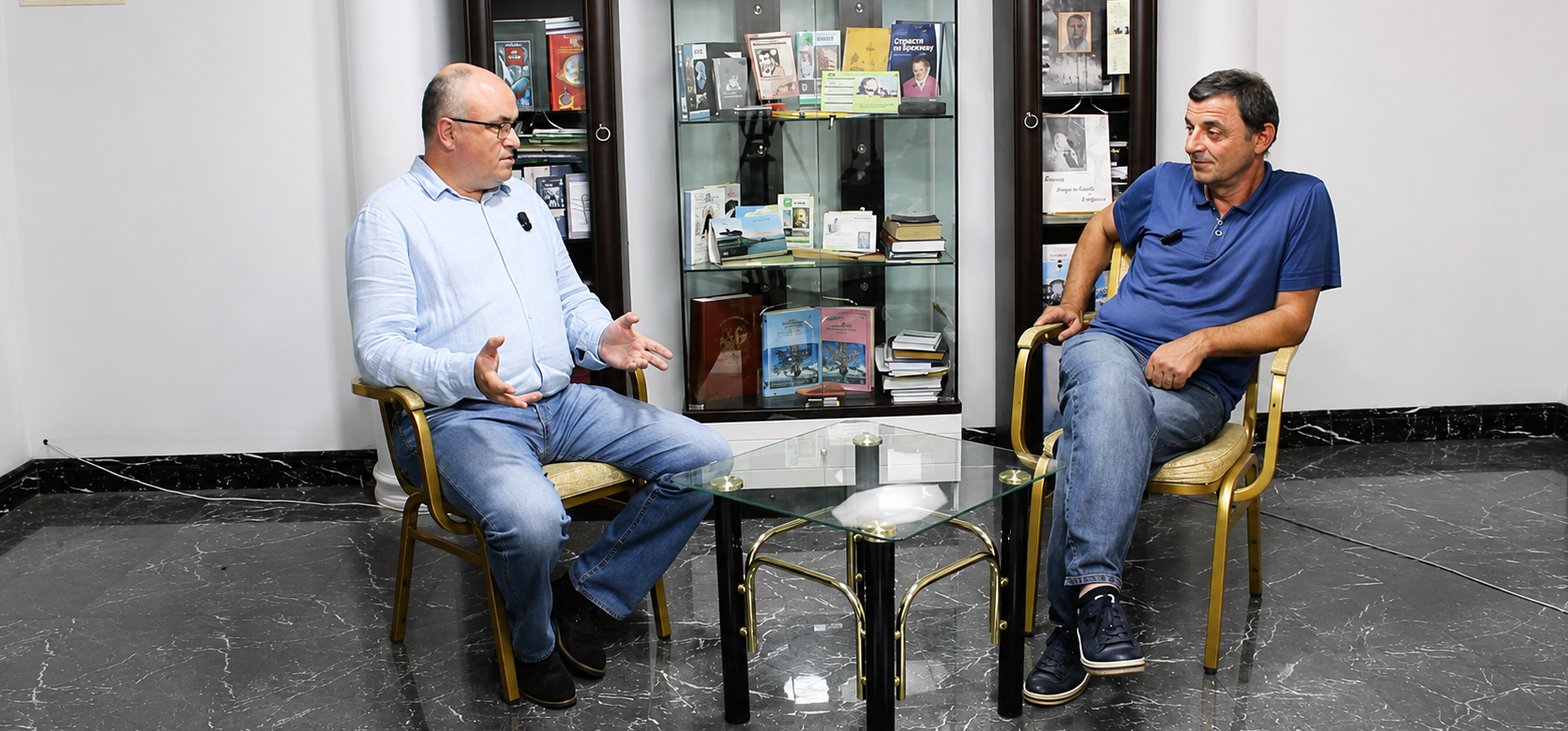
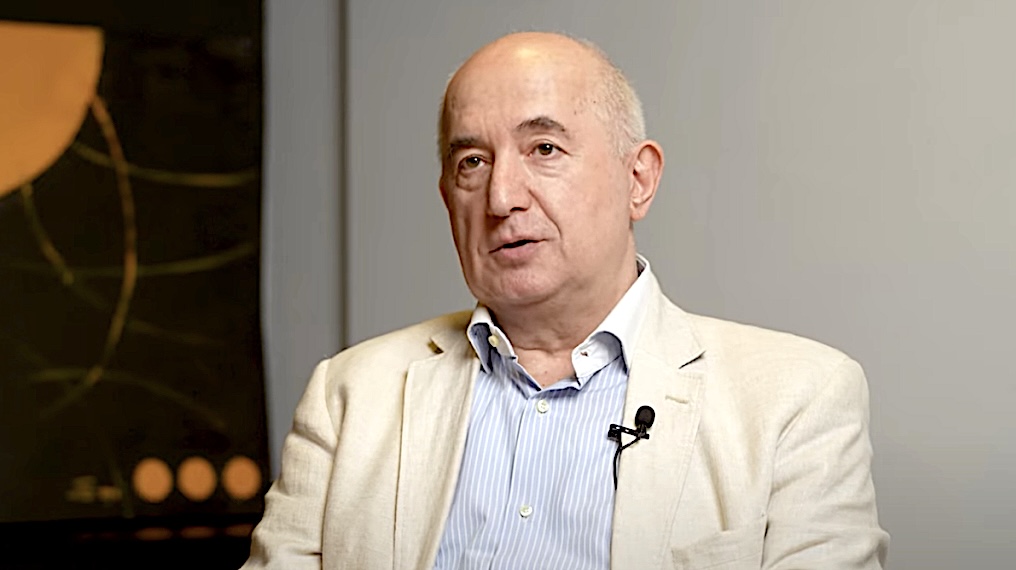
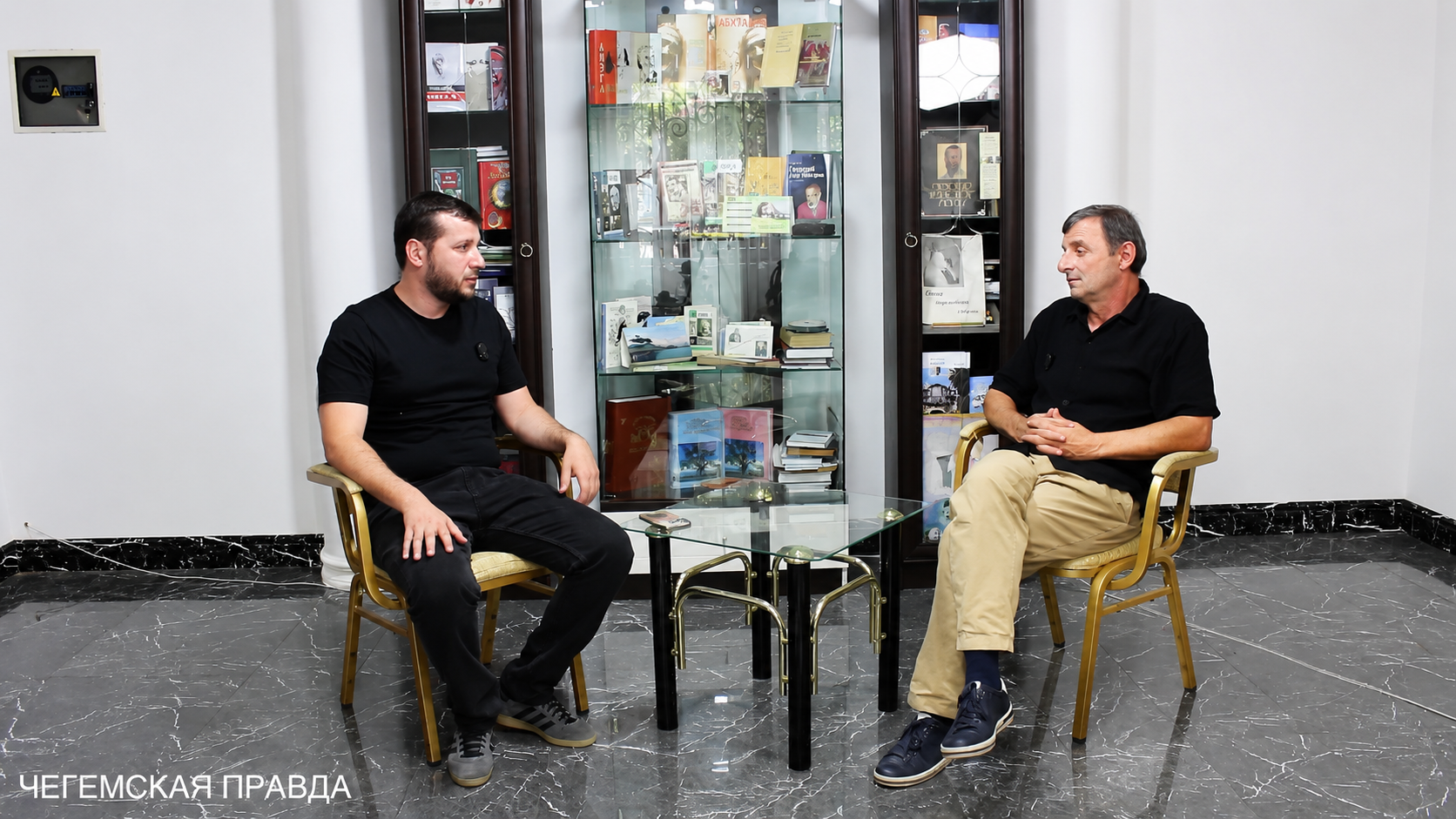
Inal Khashig, editor of the newspaper Chegemskaya Pravda, discussed the transit issue with renowned Abkhaz publicist and director Tengiz Dzhopua, whose biography includes experience working for the State Customs Committee of Abkhazia.
Full text version of the interview:
Inal Khashig: Hello, you’re watching Chegemskaya Pravda. Today we will be talking about transit, especially as there is a reason to do so.
It was recently announced that a construction taking place on the Abkhaz–Georgian border, along the Ingur River, is nearing completion. A terminal was being built there.
Based on the limited information provided by people involved in the construction, we understand that cargo transit is starting. Today we will talk about this issue based on the information that is currently available to us.
And we will also reflect on it ourselves. Our guest today is Tengiz Dzhopua, a member of the Public Chamber.
He has extensive experience working at the State Customs Committee and is one of the professional experts in this field. Tengiz, good afternoon.
There is very little information, and we still do not quite understand. There used to be a joke: “Give me a small piece of the border to lease.”
It feels like something similar may be happening. How does this correspond to reality?
Tengiz Dzhopua: Let us start by explaining what transit actually is.
Transit means movement, from an economic point of view, it means movement between two points. One point is on one section of the border, and the second point is on another section of the border.
From the perspective of customs legislation, all goods, if they are moved across the territory of our country or across the border of our state, must be placed under a specific customs regime.
We have such a regime, which has the same name.
It allows goods to be moved between customs control bodies and customs destination bodies without the collection of customs duties, taxes, or the application of economic policy measures to these goods.
There are a number of conditions. You must move the goods within strictly defined time limits. These are calculated based on the nature of the route and the type of transport used.
However, they must not exceed the timeframe calculated on the basis of 30 kilometres per day. That is, if we are transporting goods from the Gal post to the Psou post, we should be given about six days for the movement.
Another condition is that these goods must be transported under customs control. That is as far as the legislation in this area is concerned. Now, as for the situation itself.
I also listened to the director of this company, who gave an interview about this hub. The situation is as follows.
After the introduction of sanctions [against Russia], especially after the 11th package, Russia faced problems with the supply of imported products.
And Georgia is one of the countries through which parallel imports are carried out. I do not know all the details of Georgia’s customs statistics, but I can say with confidence that Georgia’s foreign trade turnover has increased several times over. Georgia has earned quite well from this.
It is enough to say that Georgia has practically paid off all of its external debts. The last debt was not fully repaid to the Russian Federation; its only remaining external debt is to France.
Inal Khashig: The system of parallel imports is not transit.
Tengiz Dzhopua: Parallel imports are a grey scheme, when goods are imported into third countries without the consent of the rights holder.
Let us give an example of how parallel imports work in Georgia.
For instance, a shipment arrives at the port of Poti. Let us say it is Pepsi-Cola. Georgia [appears] in all the documents accompanying this cargo. These include various shipping documents, including the cargo manifest. In all these documents, Georgia is listed as the country of destination.
Georgian customs clears this cargo, collects customs duties, taxes, and excise charges, and applies non-tariff regulatory measures to the goods, if such measures are not, for example, provided for under Georgian legislation.
The goods are cleared and released. That is, the owner of the cargo then has the full right to sell these goods anywhere.
But the most interesting part happens next with this cargo. The goods are then transported to Upper Lars [checkpoint at the Georgian–Russian border]
At that point, for Georgia, the cargo already becomes an export. Before that it was an import; now it is an export. The Georgian side can process it as an export, an export operation, and note it down as Pepsi-Cola.
Or it may choose not to put it down as Pepsi-Cola and instead declare some Georgian mineral water, for example Likani or Borjomi, and process the export operation for the removal of this product from Georgia.
What is the issue with such schemes?
The problem is that Georgia is a member of the WTO. Obligations under the General Agreement on Tariffs and Trade apply to it, and within this organisation there is an exchange of statistical data.
That is, the World Trade Organization may request customs statistics from Georgia. And these data are precisely the key details contained in the customs cargo declaration.
This includes the country of dispatch, the country of destination, the name of the goods, the customs value, and so on. As a result, Georgia may find itself in a difficult position.
For implementing such grey schemes, Georgia could face WTO trade sanctions or political sanctions that may be formulated somewhere in Brussels.
That is why Georgia pursues a very cautious policy. It clears part of the cargo, while another part is most likely not cleared. In other words, it moves outside the framework of customs statistics and outside the framework of official documentation.
Inal Khashig: I’ll interrupt you to clarify. Le’ts say,10 tonnes of Pepsi-Cola are brought into Georgia. It clears one tonne as being exported somewhere, while nine tonnes of this Pepsi-Cola remain. But in reality, this Pepsi-Cola also leaves — it just goes, for example, under the guise of Borjomi.
Tengiz Dzhopua: Exactly. If you are importing products — say, the same Pepsi-Cola — you have to understand that there is a certain market capacity. You cannot import hundreds of millions of tonnes of Pepsi-Cola if your population is only a few million people.
That is why part of it is cleared in a “white” format, while part of it is forcibly cleared in a “black” format [covertly].
When a ship arrives in Poti, there is a container on board, but you do not take any documents, you do not file any declarations. This ship never existed, this container never existed — nothing existed.
This is already a “black scheme.” The problem with black schemes is that once the container has been unloaded, you must send it [cargo] somewhere for storage for a short period of time and get rid of it quickly.
It has to leave the territory of your country. Because if it stays and ends up circulating on the domestic market without any payments being collected, this creates a threat to the economic security of your own state.
That is why, for Georgia, having the ability to quickly get rid of this grey import is extremely important.
They had one such option through the Upper Lars checkpoint. The road to Upper Lars runs through very difficult terrain. These are mountainous areas, with snowfalls, and sometimes even avalanches. There are times when this road is closed for quite a long period.
And if the road is closed, these grey cargos begin to accumulate. You need another corridor. That other corridor is Abkhazia.
In this sense, compared to Upper Lars, Abkhazia offers an all-season route. It is much simpler in terms of terrain. And it is located close to the main port in Poti, which receives containers. That is how this scheme came about.
Now, from the point of view of our legislation. We do not have a trade and political regime with Georgia. None at all. We are in a state of war with Georgia.
With Russia, however, we do have a trade and political regime — a duty-free one. But with Georgia, there are no relations whatsoever. We have two decrees by President Vladislav Ardzinba. As well as a resolution or another decree by President Sergei Bagapsh banning trade relations with the Georgian state.
Essentially, we are in a state of war with this country. The director of this enterprise [hub] referred to a transit document that we signed with the Federal Customs Service of the Russian Federation. Such an agreement does indeed exist.
Inal Khashig: In 2011, I believe — or in 2012.
Tengiz Dzhopua: I believe it was in 2013. In 2011, there was a transit document between the Russian Federation and Georgia. If you remember, it involved a Swiss company.
Inal Khashig: Yes, a Swiss auditing company that was supposed to be stationed on the Ingur [River] and Psou [River] to monitor cargo flows.
Tengiz Dzhopua: This document does not concern us in any way at all. Russia tried for a very long time to join the WTO — since around 1993, as far as I remember. And it had practically reached agreements with everyone.
And after 2008, Georgia withdrew from the negotiation process altogether. For some time, it did not raise this issue at all.
As far as I know, Russia exerted pressure on Georgia through European states. [They] forced Georgia to give its consent to Russia’s accession to the WTO. That is how this document came about.
Abkhazia is not mentioned in it in any way whatsoever. It refers to two corridors, Corridor 1 and Corridor 2, and their geographical coordinates.
This document does not concern us at all. This is an issue of Russia and relations between Russia and Georgia.
As for the agreement on transit between Abkhazia and the Russian Federation, that document states that it may be applied except in cases where this creates a threat to the security of the states that are the contracting parties, or causes damage to the interests of one or another party.
That is, even in this case, this document has no relation whatsoever to the situation that has now arisen for us.
Because we are in a state of war with Georgia. To demand transit from us with a country with which we not only don’t have trade and political relations, but with which we are in a state of war — this is complete absurdity.
This is the same as if we were to ask the Russian Federation to allow transit of cargo heading to Ukraine. That is nonsense.
Inal Khashig:In any case, the transit topic is interesting as an actualisation of Abkhazia’s very presence.
It is clear that with road transport, given the state of the infrastructure we have, this is quite problematic. And you cannot earn much. On the other hand, we probably could earn something if these were railway shipments.
But there is also a certain political aspect here. Even if transit does not bring in much money, [what matters is] the actualisation of this issue itself, the [very fact] of a negotiation process [with Georgia]. Not some kind of underground negotiation process, but a real negotiation process.
Since 2008, we have not been talking to Georgia at all. Georgia considers us territories occupied [by Russia] and, accordingly, does not recognise the official authorities [of Abkhazia].
They say there that Georgia needs to talk to Moscow, because Abkhazians have no subjectivity. In this context, the transit topic would be interesting if our subjectivity were actualised.
That is, we would enter into some kind of negotiations. Even given that, probably, the scheme that was developed during Russia’s accession to the WTO would work. It could also be consideredю
But what troubles me most is that Abkhazia is not fixed anywhere at all. That is strange, isn’t it?
A representative of a private company comes out and says that he represents such-and-such an organisation. He says that he has reached an agreement. A former head of Russian customs is building a terminal, and the Abkhaz authorities are silent. This is what troubles me most.
Tengiz Dzhopua: Well, first of all, this is a supply channel. A supply channel includes a huge number of elements.
And if people come out and say that they are building a terminal, that means they have already reached agreements with everyone along the entire length of this channel.
They have reached agreements in Moscow, in Tbilisi, and in Sukhum. When we say they have reached agreements, this does not mean that in Tbilisi they were talking to Kobakhidze.
It is possible that they were talking to all the services that interact at the border. And Kobakhidze is also aware of this situation.
If they say that they have reached agreements in Moscow, that means they have also reached agreements with all the services there. If you miss even one service, you will run into problems implementing this channel.
So everyone has already reached agreements with everyone. We just do not know about it. The fact that Kobakhidze came out and said that they have nothing to do with this scheme, that it is, as it were, a grey zone.
But he said what he needed to say. He is not going to say: “You know, we are engaged in grey imports, we are making huge amounts of money. We have some other shady schemes as well. And we need to move all of this to Russia through some channel.”
He will never say that. But the very fact that they paid attention to this already indicates that on their side of the border this is very important for them. It is really important for them.
Abkhazia is an additional bypass in the cargo flow. If this bypass starts working, their supply volumes will also increase, and throughput capacity will increase for Georgia itself.
Why are they silent [in Abkhazia]? I think our people are perfectly aware of this situation. [Otherwise], no one would be building a terminal on the border. Construction on the border is not allowed at all without the permission of the border and customs services.
Tengiz Dzhopua: It may be allowed. Yes, as a terminal.
What does this director [of the hub] say? He says that they are engaged in the construction of a cargo terminal. There is no such concept as a cargo terminal. Either it is a temporary storage warehouse, or a customs warehouse, or a free warehouse.
There must be some kind of legal basis. But a cargo terminal cannot simply be built by a private company. Because if foreign goods enter the customs territory of our country, they can arrive at its условно “cargo terminal” only if this terminal has some legal basis.
If, for example, it is declared as a customs warehouse, or as a temporary storage warehouse, or as a free warehouse. In that case, goods may be delivered there.
But a simple cargo terminal — such a concept does not exist at all in customs legislation. Sometimes, at posts we call a “cargo terminal” the cargo control line through which freight transport passes. But this is just slang.
I think that all the services here in Abkhazia know everything perfectly well. They just do not know what to say in this situation. The very fact that he [the hub owner] says that this issue was being dealt with six years ago suggests that the go-ahead had already been given by the previous authorities [of Abkhazia] to implement this project.
And the new authorities [of Abkhazia] have found themselves burdened with the obligations that the old authorities had already taken on. And that is why this terminal appears.
I could, for example, agree to something. Right now,society is saying that [Abkhazia] should ask for, demand the adoption of an agreement on the non-use of force.
But the Georgian side will not agree to this. How does Georgia view this situation? We deliver the cargo to you [Russia], and you then deal with the Abkhazians yourselves.
And, most likely, the burden of negotiations with the Abkhazians will be placed by the Georgians on the Russian side.
As for the fiscal benefit [for Abkhazia], the fees for these cargos amount to 0.1% of the customs value. This is an extremely negligible figure — extremely.
In practice, we are simply providing our corridor, our capabilities, to Georgia.
Georgia increases its foreign trade turnover as a result. Its state budget revenues increase. Plus, over there, the volumes of “side” payments into the pockets of officials grow thanks to these “grey schemes.” And we will receive 0.1% of the customs value.
Inal Khashig: Are these international standards? Or is the 0.1% set by our legislation?
Tengiz Dzhopua: The 0.1% is according to our legislation.
Inal Khashig: And can we somehow change this? Make this situation economically beneficial?
Tengiz Dzhopua: We can do this. By a resolution of the Cabinet of Ministers, we can increase the rate for customs clearance. That is the first thing.
We can go further. We can come up with some non-tariff measures of influence. We can do the same thing that was done in Georgia — introduce a road toll for transit.
That is, we can take certain actions, because in any case we will incur losses due to fairly heavy use of the road surface. In Georgia, a road toll is charged for this. We can do the same.
We can increase the size of the service orders that customs authorities receive. We can also increase clearance fees. We can introduce a number of conditions that would be beneficial for us.
But the problem still lies in the fact that we must provide some legal justification for the process itself. Because transit or not — this is a trade relationship with another state, with Georgia. We have to justify this somehow from a legal point of view.
Which means that we need to repeal all previously existing legal acts that prohibit any trade relations with the Georgian state.
And somehow put all of this in order from a legislative point of view. At least start with that. And further actions [can be taken] through the financial and customs committee.
Of course, it is possible to increase the share of profit that could remain with us. That can also be done. And I would also like to emphasise another aspect that is being discussed.
If over time transit begins to grow, our section of the road is much better than the route via Upper Lars. In this respect, we are very competitive.
If, over time, Georgian cargo flows begin to move through this territory, and this road gradually becomes significant, it could bring us political dividends. We would be able to use it as a certain lever of pressure on some issues. Not major ones, perhaps, but at least some issues.
This would be a lever of pressure on Georgia. Because closing or blocking this road would have certain economic consequences for it.
But this requires a long period of time. Several years would have to pass. And right now, in the current situation, all we can do is increase certain fees.
Inal Khashig: It seems to me that it is clear that, in the form in which road transit is currently being carried out, it is economically unprofitable.
[Yes], this situation can be used to advance certain other political objectives facing our state. But on the other hand, it is clear that since the collapse of the Soviet Union, no new roads have been built here at all.
At present, there is a dead end, a lack of through traffic — we only have a road open in one direction. Even so, during the summer season we feel that everything is under strain.
I am now looking at the long-term perspective: Abkhazia will still resolve its conflict someday. And this through road connection will have to open.
But for it to open, a certain infrastructure must be created. Before the collapse of the Soviet Union, a transit bypass road had been partially built, but it was never completed. In different parts of Abkhazia, you can see huge pillars on which the roadbed itself was supposed to be constructed.
If we talk about prospects — if such a through road connection were suddenly to open — then, probably, there [should be] commitments regarding the future construction of such a bypass road. This could also be included.
There is a lot that could be included here. If in reality this brings us no economic dividends. And no political dividends either. Then, accordingly, something must be included that would be of interest to Abkhazia.
I am not talking about anything revolutionary [such as telling Georgia]: recognise us. But there is a law on occupation [in Georgia], there are many other things that could be played on. There is room for manoeuvre.
Tengiz Dzhopua: I think we need to look at the situation more soberly. A bypass road requires colossal capital investment. This company [the hub] that has opened here does not have such capabilities at all. It simply has none.
For economic justification and interest in building this road to arise, the cargo flow and vehicle flow through Abkhazia would have to be simply critical.
And our infrastructure would not withstand it. We would hit a dead end here sooner than any investor would even get the idea: let’s build this [bypass] road.
I am inclined to think that the railway could be used more effectively than the road section through Abkhazia. The railway would [have a much greater capacity] to handle cargo flows by volume than road transport. And it would cause fewer problems for the population of the country.
In the summer period, for example, I cannot even imagine how these cargos would be moved through [Abkhazia].
If this scheme starts to work, it will probably be necessary to ban, as is sometimes done in Russia, the movement of oversized cargo during certain periods. For example, to allow it only at night.
Something like that would probably have to be done in the summer. Because with the density of road traffic that already exists on our roads, this will be a problem for all of us.
The people who are dealing with this now, I am more than sure that they got an opportunity to make money from it. The investments there are not very large.
They say they have built some kind of cargo terminal. Well, these are not critical investments either.
The warehouses they say they are going to open — a customs warehouse, a temporary storage warehouse. A customs warehouse is an open site, a concreted area, fenced off for storing sea containers — 20-foot, 40-foot.
There is nothing else there — just a fenced-off field, that’s all. So I do not think they have any financial capabilities such that our authorities could demand something from them in the future. I doubt that.
A state must have its own economic policy. A state must have its own will, its own interests.
This director [of the hub] should not have spoken at all. First, probably, the minister of economy [of Abkhazia] or the minister of foreign affairs should have spoken. They would have explained to the population why we are suddenly starting trade relations with the Georgian state. What benefit this transit regime could bring us.
They [the authorities] keep saying that there is a special military operation going on [in Russia], and that this is vital [for Russia].
But in all seriousness, Georgia will never allow dual-use goods to pass through its territory.
Georgia lets through consumer goods — those that have ended up on sanctions lists. Talking about the usefulness of such imports for Russia is a very difficult question. It creates problems for its domestic import-substitution efforts
So it is certain at all whether what Georgia is doing — its parallel imports — benefits the Russian side or not.
But the fact that it benefits certain private groups that are making good money is beyond doubt.
So I think these are simply people who want to make money. They saw this opportunity to earn. And as sanctions [against Russia] expand, the margin on these operations grows higher and higher.
They opened this terminal. I think their scope of work there is absolutely negligible. A container arrives. They will unload this container. Most likely unload it, because all containers have markings and an identification number
If, for example, a container arrived at the port of Poti, it cannot end up in Murmansk in any way. It must be in Poti. It must re-enter global trade again from Poti.
Therefore, at most, they will have to unload the containers and reload them onto road freight transport — and that’s it. They have no other work.
They say they are going to install some kind of X-ray equipment there. In the customs system, the main X-ray equipment used to inspect 20-foot and 40-foot containers is a small inspection and screening complex. They are called IDCs. One like this is located at the vehicle base in Adler.
There are also stationary ones, but they are even more expensive. But even these IDCs costs between 100 and 200 million. And you cannot buy a used one — you have to buy a new one.
This is extremely technically complex equipment that requires highly qualified specialists, who also need to be trained separately.
And in general, the idea that they are going to install some kind of X-ray equipment there, with which containers will be inspected, sounds absurd.
Some other equipment, I don’t know, with which containers can be inspected.
So this is simply a scheme.People realised that money could be made from this. They came to Abkhazia and made an offer to our leadership, because without that nothing is possible.
And the leadership counted the money. Not the moral side of the issue — that we are at war with the Georgians, that we are in a state of war with them, that this is primarily beneficial for Georgia.
We are, in fact, constantly pouring water on their mill. And we gain nothing from this.
But the people [in the Abkhaz government], I think, calculated their own incomes. And they agreed. That is what we have.
Inal Khashig: In reality, we do not know the terms. And it would be preferable to wait for some kind of official statement on this matter.
Unfortunately, there is [no] official [statement] not only on this issue, but on many things. We have huge problems with this.
Nevertheless, I would not say that the topic of transit itself is taboo for our state. We say that we want to be a normal country, with the ability to trade with different countries, to be a participant in communications [projects], in all this logistics.
Nevertheless, it is probably necessary to explain on what terms. Even if it may be an unpopular decision, you still have to announce it.
The strangest thing in this story is that it is a private individual who is talking about the topic of transit, about the fact that a terminal has been built [in Abkhazia]. Not the state speaking, not a representative of the authorities. That is the strangest thing in this story.
Whether this transit can exist or not is probably a secondary issue. At the very least, the authorities should have their own calculation as to why all this should be carried out. They take the hit upon themselves. That is why they are elected — to weigh the risks and so on. This is their responsibility.
But when instead of the state some representative of a private company comes out on issues where the state should be dealing with this, it looks very strange. That is the first point.
On the other hand, it seems to me that what matters is not only the transit issue itself.
Astamur Tania likes to speak in more legal-political, legal terms. He talks about subjectivity. I do not think that many people in the system of power understand what real subjectivity is.
Subjectivity is when you act based on your constitution, your legislation — that is what subjectivity is. That is probably the explanation I would give.
I will probably wrap up our conversation. Tengiz, thank you very much.
I will remind our viewers that today we talked about transit. I, at least, am not against transit. But the question is — on what terms?
In 2022, a working group was created under the president on the possibility of transit. I was part of this working group. I was in favour of transit.
But again, everything depended on the terms. The most important thing in this matter is the terms.
Subscribe to us. Watch our programme. You can like and comment.
Once again, thank you very much, and see you next time.